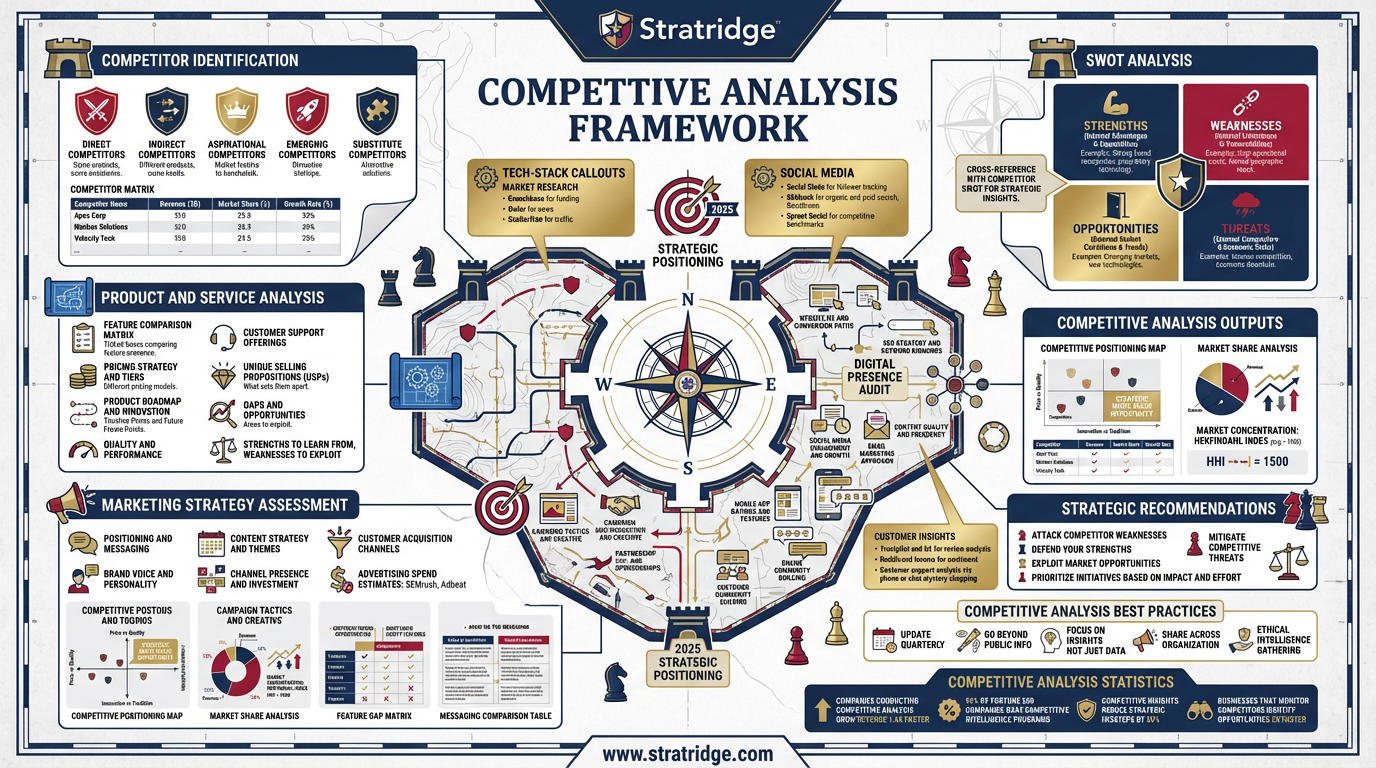
For B2B SaaS CMOs, the challenge isn't a lack of competitive data; it's transforming that raw intelligence into executive-level insights that drive strategic decisions. Presenting a laundry list of competitor features to the executive team is a fast track to glazed-over eyes and missed opportunities. The real problem lies in translating granular competitive signals into a coherent narrative that frames strategic choices, mitigates risks, and illuminates pathways for market advantage. Without this translation, competitive intelligence remains an academic exercise, failing to inform the critical discussions that shape your company's future.
Beyond the Feature List: Framing Competitive Insights for Executives
Executive teams operate at a different altitude. Their focus is on market share, revenue growth, strategic positioning, and long-term viability. When presenting competitive intelligence, the goal is not to showcase every competitor's latest release, but to distill complex information into clear, actionable strategic implications. This requires a shift from reporting what competitors are doing to explaining why it matters to your business objectives.
Consider the strategic questions competitive intelligence should answer for an executive team:
- Where are we vulnerable, and what are the immediate threats?
- What emerging opportunities can we capitalize on?
- How are market dynamics shifting, and what does that mean for our long-term strategy?
- Are there competitive moves that necessitate a strategic response?
Your presentation must directly address these types of questions, providing context and recommendations rather than just observations. This means prioritizing signals, connecting them to your company's strategic goals, and offering a clear path forward.
Prioritizing Competitive Signals: The Strategic Relevance Matrix
Not all competitive signals are created equal. An executive team needs to understand the signals that carry the most strategic weight. To achieve this, employ a prioritization framework that filters out noise and highlights critical developments. The Strategic Relevance Matrix helps categorize competitive activities based on their potential impact on your business and the likelihood of that impact occurring.
Here's how to construct and utilize this matrix:
This matrix provides a visual and logical framework for discussing competitive threats and opportunities, ensuring executive attention is directed towards the most critical areas. It moves the conversation from 'what they did' to 'what we should do about it.'
Framing Competitive Intelligence as Strategic Decisions
Once prioritized, competitive signals must be framed as strategic decisions rather than mere observations. This involves presenting the competitive context, outlining the potential implications for your business, and proposing a set of strategic options. The goal is to facilitate a discussion that leads to a clear decision or a defined action plan.
Elements of a Strategic Decision Frame
For example, instead of stating, "Competitor X launched a new AI feature," frame it as: "Competitor X's new AI feature could erode our market share in the mid-market segment by Q3. We have three strategic options: accelerate our own AI roadmap, partner with an AI provider, or differentiate on service and support. My recommendation is to accelerate our AI roadmap by reallocating engineering resources, as this aligns with our long-term vision for product leadership."
This approach transforms competitive intelligence from a reporting function into a strategic advisory role, directly contributing to executive-level decision-making. For more on crafting executive communications, see Executive Briefing: Positioning for the Board Deck.
Avoiding the 'Feature List' Trap: Focus on Value and Positioning
The 'feature list' trap is a common pitfall where competitive intelligence devolves into a side-by-side comparison of product functionalities. While feature parity is important for product teams, it rarely provides the strategic insights executives need. Instead, focus on how competitive features translate into value propositions and impact market positioning.
When a competitor launches a new feature, ask:
- What customer problem does this feature solve for them?
- How does it alter their value proposition or strengthen their market positioning?
- Does it create a new category or redefine an existing one?
- How does this impact our unique selling proposition and competitive differentiation?
By focusing on value and positioning, you elevate the conversation from tactical product comparisons to strategic market dynamics. This perspective helps executives understand the broader implications of competitive moves and how to adjust your own competitive differentiation when product is mostly the same.
The Role of Battle Cards in Executive Communication
While battle cards are often seen as a sales enablement tool, their underlying principles of concise, actionable competitive insights are highly relevant for executive communication. Think of an executive-level battle card as a high-level summary that provides immediate context and strategic responses to key competitive threats or opportunities.
These are not detailed sales battle cards, but rather strategic snapshots. They ensure that executives are equipped with the essential information to discuss competitive dynamics confidently and consistently, both internally and externally. For more on building effective battle cards, refer to Build Battle Cards Sales Actually Uses.
Continuous Monitoring and Adaptive Briefings
Competitive landscapes are dynamic. A one-off presentation, no matter how well-crafted, will quickly become outdated. Executive communication around competitive intelligence must be an ongoing process, supported by continuous monitoring and adaptive briefings. This ensures that the executive team is always operating with the most current and relevant information.
Establish a cadence for competitive intelligence updates – whether it's a monthly strategic review, a quarterly deep dive, or ad-hoc briefings for significant events. The format can vary, but the principles remain constant: prioritize, frame strategically, and focus on implications for decision-making.
Leverage tools and processes for competitor monitoring vs. Google Alerts to ensure you're capturing the right signals efficiently. The goal is to create a system where competitive insights flow seamlessly into executive discussions, enabling proactive rather than reactive strategy adjustments. This continuous feedback loop is crucial for maintaining a strong market position and adapting to evolving threats and opportunities.
Mastering the art of presenting competitive intelligence to the executive team is not just about reporting; it's about strategic leadership. By translating raw data into actionable insights, framing competitive moves as strategic decisions, and avoiding the feature list trap, you empower your leadership to make informed choices that drive market advantage. Stratridge provides the positioning and go-to-market intelligence to help you continuously scan the competitive landscape, gain visibility into emerging threats, and brief your executive team with confidence, ensuring your strategy is always robust and responsive.
Keep reading
Executive Briefing: Positioning for the Board Deck
How to explain positioning to a board — the four slides that matter, the metrics to pair with each, and the reason most positioning slides get skipped in the read-ahead.
Competitor Monitoring vs. Google Alerts: Why You're Losing Intelligence
Google Alerts is a headline feed, not a competitor-monitoring tool. Here's what it catches, what it misses, and what a real monitoring setup looks like.
How to Build Battle Cards That Sales Actually Uses
Tactical guide to battle cards that field reps open during live deals — not the ones that rot in Drive two weeks after they ship.
Positioning Brief
One page that keeps your whole team telling the same story.
The Positioning Brief is a living, one-page document the Analyst re-writes as your pillars, signals, and decisions change. Short enough for the board to read in four minutes, specific enough for a new hire to use on day one.
- ✓One page — readable by the board in four minutes
- ✓Re-writes itself as your market and strategy evolve
- ✓Bridges the gap between strategy and execution