Securing Series B and C funding for your B2B SaaS company demands more than just strong product-market fit and revenue growth. Institutional investors are increasingly scrutinizing the underlying mechanisms of that growth, and a compelling marketing narrative is no longer a 'nice-to-have' – it's a critical component of your fundraising success. Founders often struggle to translate complex marketing strategies into a clear, investor-friendly story that highlights predictable, scalable growth. This isn't about marketing fluff; it's about demonstrating a robust, data-driven engine that fuels your company's future.
Crafting Your Go-to-Market (GTM) Narrative for Investors
Your GTM narrative for fundraising is distinct from your customer-facing messaging. While the latter focuses on solving customer pain points, the investor narrative centers on how your GTM strategy creates defensible market share, scalable customer acquisition, and predictable revenue streams. Investors want to understand the 'how' behind your growth, not just the 'what'. This requires a strategic articulation of your channels, customer journey, and the economic levers you pull.
Begin by outlining your target market segments with precision. How do you identify, reach, and convert these segments? Detail your primary and secondary acquisition channels, explaining why these channels are effective and how they scale. Avoid jargon; instead, focus on the strategic intent and measurable impact of each component. For example, if content marketing is a key channel, explain how it generates qualified leads, reduces CAC, and supports sales velocity, rather than simply listing content types.
Key Elements of an Investor-Ready GTM Narrative:
GTM Narrative Checklist for Fundraising
This narrative should seamlessly integrate with your overall business strategy, demonstrating marketing as a core driver, not just a support function. For a deeper dive into structuring your overall business strategy, consider reviewing the principles of Strategic Context: Why Strategy Docs Become Graveyards.
Market Sizing: Proving the Opportunity and Your Share
Investors need to believe in the size of the prize. Your market sizing presentation must be robust, credible, and clearly articulate both the Total Addressable Market (TAM) and your achievable Serviceable Obtainable Market (SOM). This isn't just about presenting large numbers; it's about demonstrating a clear path to capturing a significant portion of that market through your GTM and product strategy.
Start with a top-down analysis, using reputable third-party research to establish the TAM. Then, pivot to a bottom-up approach, demonstrating how your specific customer profiles and current acquisition rates translate into a realistic SOM. This dual approach provides both macro-level validation and micro-level credibility. Crucially, explain how your marketing efforts are designed to penetrate and expand within this SOM.
Visualizing Your Market Opportunity:
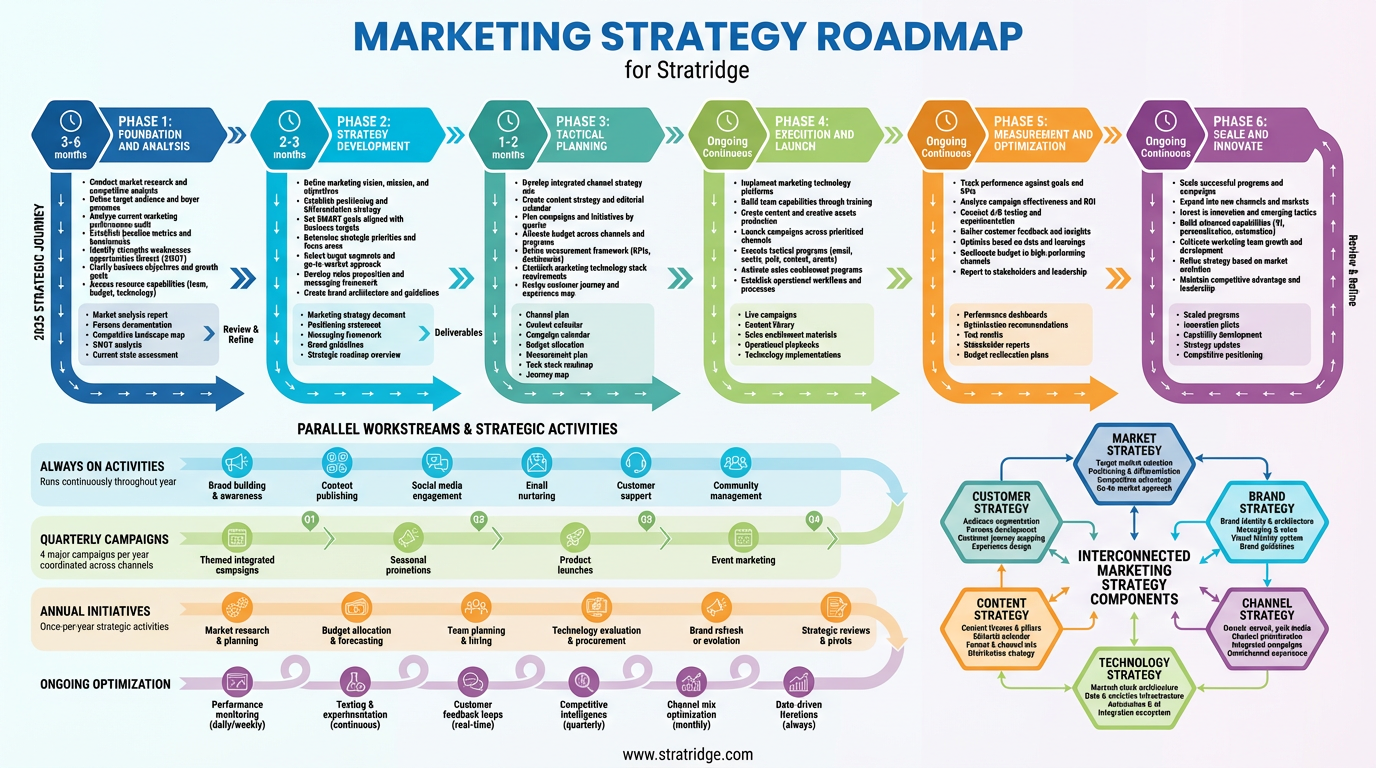
This infographic illustrates how a well-defined marketing strategy roadmap underpins your market penetration efforts. Your market sizing presentation should not only define the market but also show how your marketing activities are directly aligned with capturing and expanding your share within it. This includes detailing your Category Design for B2B SaaS: 18-Month Playbook if you are creating a new market or significantly redefining an existing one.
Quantifying Marketing's Contribution to Growth
This is where many founders falter. It's not enough to say marketing is 'doing well'; you must quantify its direct impact on key growth metrics that resonate with investors. This means moving beyond vanity metrics and focusing on pipeline generation, customer acquisition cost (CAC), customer lifetime value (CLTV), and the efficiency of your marketing spend.
"Show me the money, or at least show me the pipeline that leads to the money, and how marketing is the engine driving it."
Investors want to see a clear return on marketing investment (ROMI). Present a dashboard of key performance indicators (KPIs) that directly link marketing activities to revenue outcomes. This includes:
- Marketing Sourced Pipeline: The value of opportunities directly generated by marketing efforts.
- Marketing Influenced Pipeline: The value of opportunities where marketing played a significant role in nurturing.
- CAC Payback Period: How quickly the revenue from a new customer covers the cost of acquiring them.
- CLTV:CAC Ratio: A critical indicator of the long-term viability and profitability of your customer acquisition strategy.
- Marketing Efficiency Ratio (MER): Total revenue divided by total marketing spend, demonstrating overall efficiency.
Presenting Marketing's Impact: A Step-by-Step Approach
When presenting these metrics, ensure they are contextualized within your overall financial model. Investors are looking for consistency and predictability. Your marketing contribution should align with the broader Building a Revenue Architecture: From Lead Capture to Closed-Won that underpins your growth projections.
Building a Cohesive Executive Communication Strategy
Your marketing narrative for fundraising is a subset of your broader executive communication strategy. It needs to be concise, compelling, and consistent across all investor touchpoints. This means aligning your pitch deck, investor updates, and one-on-one conversations around a singular, powerful story of marketing-driven growth.
Consider how your marketing team's structure and capabilities support this narrative. Are you investing in the right talent and technologies to execute your GTM strategy effectively? Investors will often probe into the operational aspects of your marketing engine. Be prepared to discuss your team, tech stack, and processes that enable scalable growth.
Bridging Marketing and Investor Relations:
This distinction is crucial. While the underlying data and strategy are the same, the framing and emphasis shift significantly. For more insights on executive-level communication, especially for board presentations, refer to Executive Briefing: Positioning for the Board Deck.
The Role of Positioning in Investor Confidence
At Series B and C, investors are looking for companies that have moved beyond initial product-market fit to establish a clear, defensible position in the market. Your marketing narrative must reflect this maturity, demonstrating how your positioning strategy creates a competitive moat and drives predictable demand. This isn't just about what you say; it's about how your marketing actions reinforce your unique value proposition.
Effective positioning translates directly into investor confidence. When you can articulate not just what you do, but why you are uniquely suited to win in a specific market segment, you de-risk the investment. Your marketing strategy should be a testament to this positioning, showing how every campaign, channel, and message reinforces your distinct advantage.
Your ability to articulate a clear, compelling marketing narrative for fundraising is a direct reflection of your strategic acumen as a founder. It demonstrates not only your understanding of marketing's power but also your capacity to translate that power into tangible, investor-friendly outcomes. This strategic clarity is what separates companies that secure follow-on funding from those that struggle.
Mastering the marketing narrative for Series B and C fundraising is about more than just securing capital; it's about building a foundation for sustained, scalable growth. Stratridge provides the intelligence and frameworks to help B2B SaaS founders articulate their marketing strategy with precision, ensuring your story resonates with institutional investors and positions your company for its next phase of expansion.
Keep reading
Executive Briefing: Positioning for the Board Deck
How to explain positioning to a board — the four slides that matter, the metrics to pair with each, and the reason most positioning slides get skipped in the read-ahead.
Building a Revenue Architecture: From Lead Capture to Closed-Won
A technical guide for CMOs and marketing ops leaders on designing a full-stack revenue system, covering lead capture, scoring, routing, enrichment, CRM hygiene, and handoff protocols to optimize the entire revenue funnel.
Category Design for B2B SaaS: The 18-Month Playbook
A step-by-step 18-month playbook for B2B SaaS CMOs to design, launch, and establish a new software category, covering naming, POV, ecosystem building, and PR/AR strategy.
Launch Playbook
Ship launches that land a point of view — not just a feature list.
Launch Playbook drafts your announcement copy, FAQ, and battle-card patch from your Strategic Context the moment you're ready to ship. Evidence-based, grounded in your positioning, built to be sent — not just presented.
- ✓Drafts announcement, FAQ, and battle-card patch
- ✓Built on your positioning, not a generic template
- ✓Ready to ship in the time it takes to brief an agency