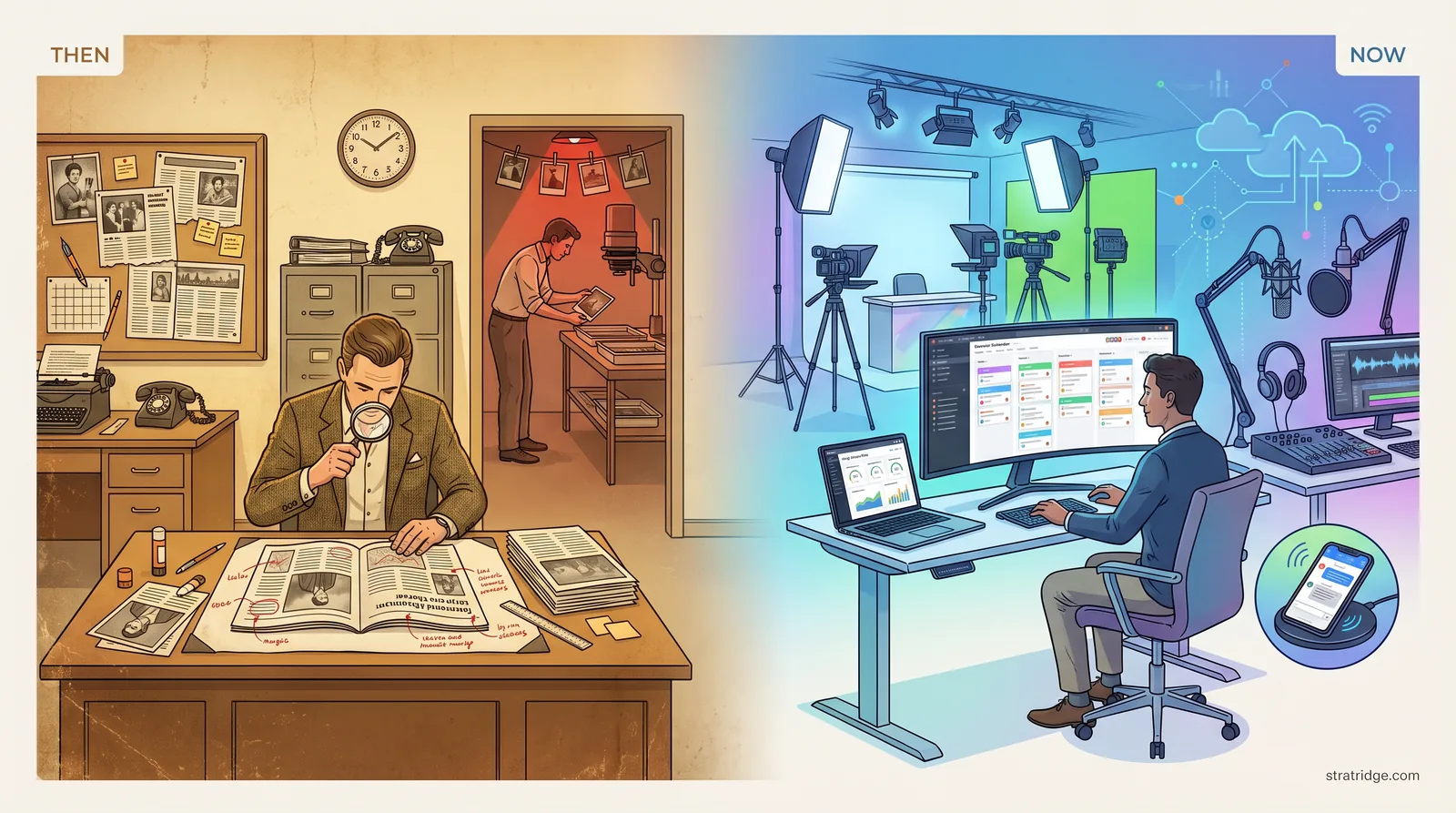
From printed magazines to always-on digital content ecosystems
Key contrasts
- Brand Magazines → Content Hubs. Brands published physical magazines for customers; today, digital content hubs serve as always-available resource centers.
- Editorial Calendars → Real-Time Content. Content was planned months in advance; agile content teams now respond to trending topics and cultural moments in real time.
- Broad Topics → SEO-Driven Strategy. Content was created based on editorial judgment; today, keyword research and search intent drive content strategy decisions.
- Print Photography → Multi-Format Production. Content meant photography and copy; modern content encompasses video, audio, interactive tools, infographics, and live streams.
- One-Time Publication → Evergreen Optimization. Articles were published and forgotten; content is now continuously updated, repurposed, and optimized for ongoing performance.
- Awareness Only → Full-Funnel Content. Content was primarily for brand awareness; today, content is mapped to every stage of the customer journey from discovery to retention.
- Vanity Metrics → Revenue Attribution. Content success was measured by readership; sophisticated attribution now connects content consumption to pipeline and revenue.
- Owned Media as Supplement → Owned Media as Strategy. Content was a supplement to paid advertising; for many brands, owned media is now the primary driver of customer acquisition.
Why brands became publishers
Content marketing is often described as a modern innovation, but its roots extend back to the late nineteenth century — John Deere's 'The Furrow' magazine, launched in 1895, is frequently cited as one of the earliest examples of a brand using editorial content to build customer relationships. What has changed is not the fundamental insight, but the scale, speed, and sophistication with which that insight can be applied.
The digital era transformed content marketing from a niche discipline into a central pillar of marketing strategy. The combination of search engines — which reward brands that produce authoritative, relevant content with organic visibility — and social media — which provides distribution channels for content that resonates — created powerful incentives for brands to invest in content creation at scale.
This created both opportunity and challenge. The opportunity was clear: brands that produced genuinely useful content could earn attention, build authority, and generate leads without paying for every impression. The challenge was equally clear: producing content at the volume and quality required to compete in a crowded digital landscape demanded significant investment in talent, technology, and process.
Today's most effective content marketing operations function more like media companies than marketing departments. They employ editors, videographers, podcasters, and data analysts. They measure performance not just by traffic and engagement but by the contribution of content to pipeline and revenue. The distance between a brand's content hub and a professional media property has never been smaller.
Content marketing has evolved from occasional brand publications to sophisticated, always-on media operations that drive measurable business outcomes across the full customer journey.
Keep reading
Then & Now: The Shift in Brand Storytelling
From the single big campaign to always-on content — how brand storytelling became a year-round media operation rather than a seasonal event.
Then & Now: The Change in Email Marketing
From batch-and-blast to intelligent personalization — how email survived every eulogy and became one of marketing's sharpest channels.
Then & Now: The Evolution of Brand Identity
From static logos to living, dynamic brand systems — how brand identity shifted from a style-guide artifact to an operating system.