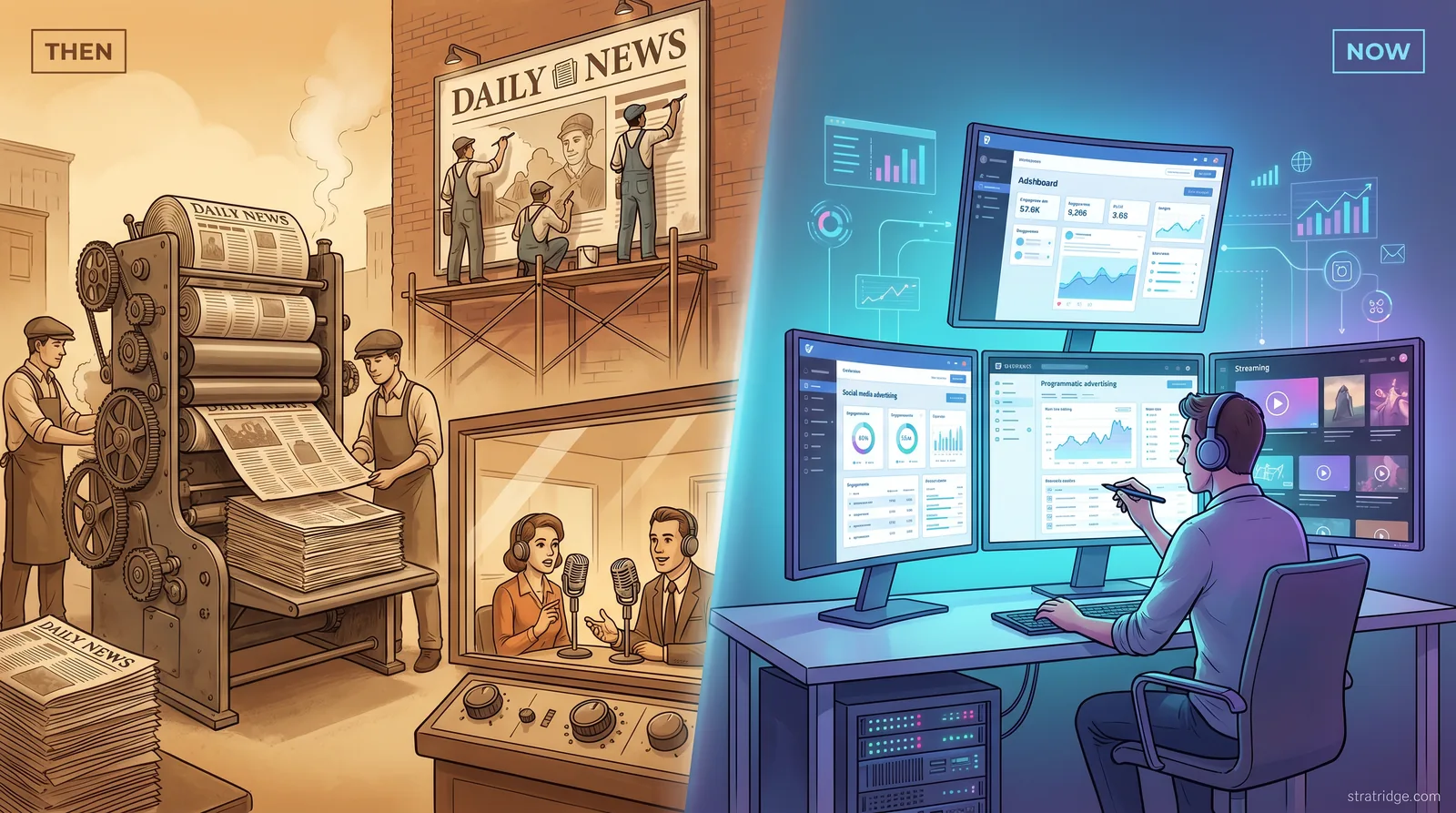
From print and broadcast to programmatic and streaming
Key contrasts
- Print Dominance → Digital Proliferation. Newspapers and magazines once commanded the lion's share of ad budgets; digital channels now capture the majority of global spend.
- Broadcast Schedules → On-Demand Targeting. TV and radio ads ran on fixed schedules reaching mass audiences; programmatic ads now reach specific individuals in real time.
- One-Way Messaging → Interactive Engagement. Traditional channels delivered messages without feedback; digital channels enable immediate two-way interaction with consumers.
- Estimated Reach → Precise Attribution. Advertisers once estimated how many people saw an ad; today every impression, click, and conversion is tracked and attributed.
- Long Lead Times → Real-Time Optimization. Print and broadcast campaigns required weeks of planning; digital campaigns can be launched, adjusted, and paused within hours.
- Geographic Constraints → Global Reach. Local newspapers and regional TV limited reach; digital platforms allow brands to reach audiences in any country instantly.
- Fixed Formats → Dynamic Creative. Traditional ads had fixed formats; digital advertising supports dynamic creative that adapts to the viewer's context and behavior.
- Siloed Channels → Integrated Ecosystems. Channels once operated independently; today's media mix is an integrated ecosystem where each channel informs the others.
Why precision replaced reach
The advertising channel landscape has been transformed beyond recognition over the past three decades. In the era of print and broadcast dominance, a brand's media strategy was relatively straightforward: buy space in newspapers, purchase time on television and radio, and hope the message reached enough of the right people. The tools were blunt, the feedback was slow, and the measurement was largely inferential.
The digital revolution dismantled this model systematically. First came display advertising on websites, then search ads, then social media, then programmatic buying — the automated, real-time auctioning of ad inventory that now accounts for the vast majority of digital display spend. Each wave brought greater precision, faster feedback, and more granular control over who sees what message and when.
Streaming has further accelerated the fragmentation. As audiences migrated from broadcast television to platforms like YouTube, Netflix, Spotify, and connected TV, advertisers followed — developing new formats suited to an on-demand, skippable, interactive media environment. The passive viewer of the broadcast era has become an active, distraction-prone consumer who must be earned rather than simply reached.
The implications for marketing strategy are profound. Channel selection is no longer a matter of choosing between a handful of options but of orchestrating a complex, multi-platform ecosystem where each touchpoint plays a specific role in the customer journey. The brands that thrive are those that understand not just where their audiences are, but how those audiences behave differently across every channel they inhabit.
Advertising channels have evolved from mass broadcast to precision digital ecosystems, fundamentally changing how brands reach and engage their audiences.
Keep reading
Then & Now: The Rise of Influencer Marketing
From celebrity endorsements to micro-influencers — how influencer marketing traded star power for trust, and reach for resonance.
Then & Now: The Transformation of Customer Data
From paper records to real-time AI-driven intelligence — how customer data evolved from filing cabinet to predictive engine.
Then & Now: The Transformation of Market Research
From focus groups and surveys to real-time social intelligence — how market research traded scheduled studies for continuous signal.