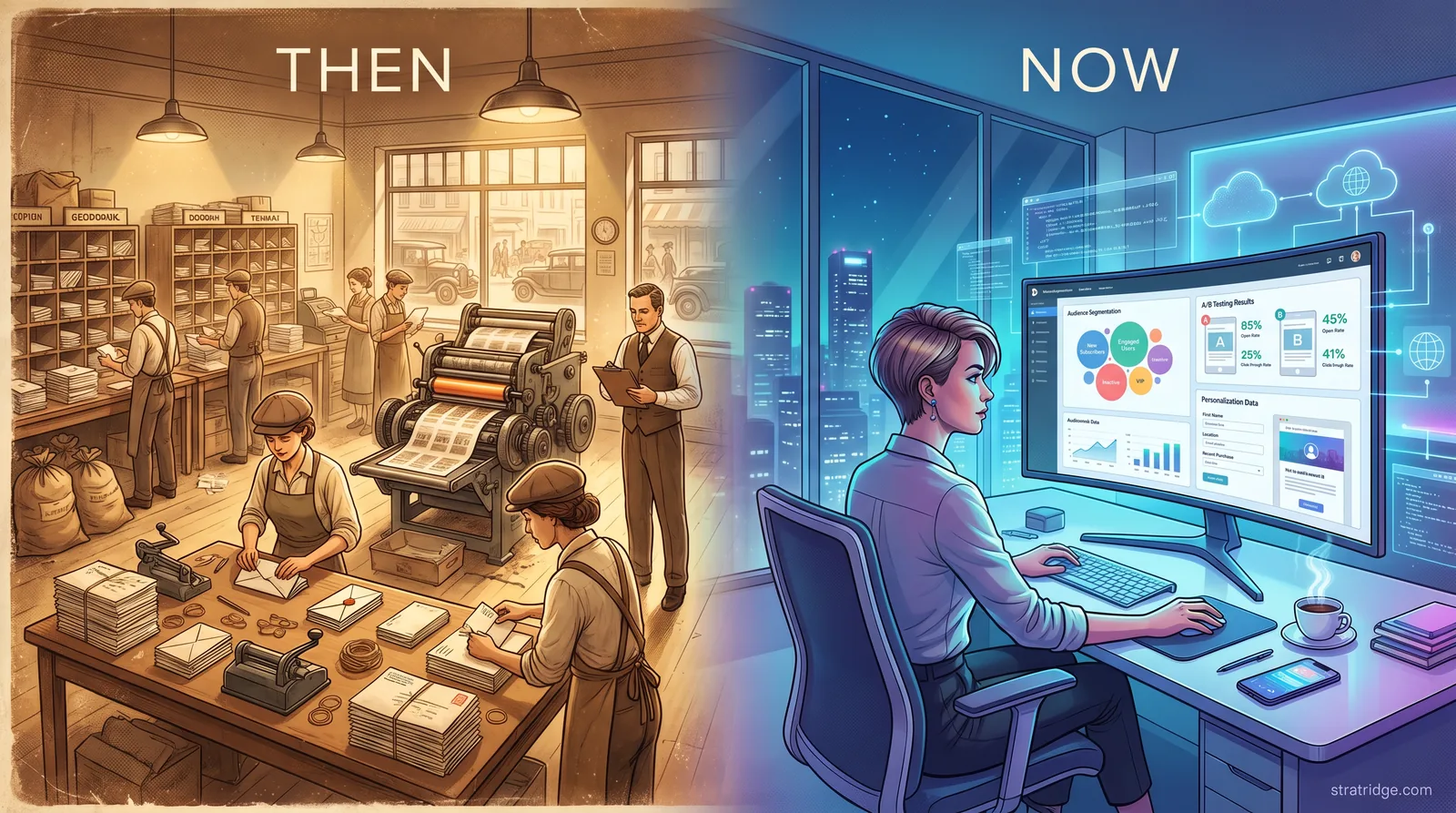
From batch-and-blast to intelligent personalization
Key contrasts
- Mass Blasts → Behavioral Triggers. Email once meant sending the same message to everyone; today, emails are triggered by specific behaviors and lifecycle moments.
- Static Lists → Dynamic Segments. Marketers maintained fixed lists; modern platforms build dynamic segments that update in real time based on customer actions.
- One-Size Copy → Personalized Content. Every subscriber received identical copy; personalization engines now tailor subject lines, content, and offers to each individual.
- Manual Scheduling → Automated Sequences. Campaigns were manually scheduled; automation now orchestrates complex multi-step sequences without human intervention.
- Open Rate Only → Full-Funnel Attribution. Success was measured by opens; today email performance is tracked through clicks, conversions, revenue, and lifetime value impact.
- Plain Text → Rich Interactive Formats. Early emails were plain text or basic HTML; modern emails include video thumbnails, carousels, and interactive elements.
- Broadcast Channel → Relationship Channel. Email was treated as a broadcasting tool; leading brands now use it as their most intimate, high-value relationship channel.
- Spray and Pray → Test and Optimize. Campaigns were sent without testing; A/B and multivariate testing now continuously optimize every element of email performance.
Why relevance became the real subject line
Email marketing has survived every prediction of its demise to emerge as one of the most effective channels in the modern marketer's toolkit — but the email marketing of today bears almost no resemblance to its origins. In the early days of digital marketing, email was essentially a digital version of the mass mailer: the same message, sent to everyone on the list, at the same time.
The evolution began with segmentation — the recognition that different customers have different needs and that relevance drives response. As email service providers grew more sophisticated, marketers gained the ability to divide their lists by demographics, purchase history, and engagement level. The results were immediate and dramatic: more relevant emails generated higher open rates, better click-through rates, and significantly more revenue per send.
Automation took this further. Behavioral triggers — the abandoned cart email, the post-purchase follow-up, the re-engagement sequence — transformed email from a broadcast channel into a responsive, always-on communication system. Today's email programs can orchestrate hundreds of different message sequences simultaneously, each tailored to where an individual customer is in their relationship with the brand.
The most sophisticated email programs now incorporate machine learning to optimize send times, predict churn, and personalize content at the individual level. What began as a blunt instrument has become one of the most precise and measurable channels in marketing — and for many brands, the channel with the highest return on investment of any in their mix.
Email marketing has transformed from indiscriminate mass blasts to precisely personalized, behaviorally triggered communication — making it more powerful than ever.
Keep reading
Then & Now: The Shift in Brand Storytelling
From the single big campaign to always-on content — how brand storytelling became a year-round media operation rather than a seasonal event.
Then & Now: The Evolution of Brand Identity
From static logos to living, dynamic brand systems — how brand identity shifted from a style-guide artifact to an operating system.
Then & Now: The Shift in Customer Engagement
From call centers to omnichannel experience orchestration — how customer engagement turned from cost center into loyalty engine.