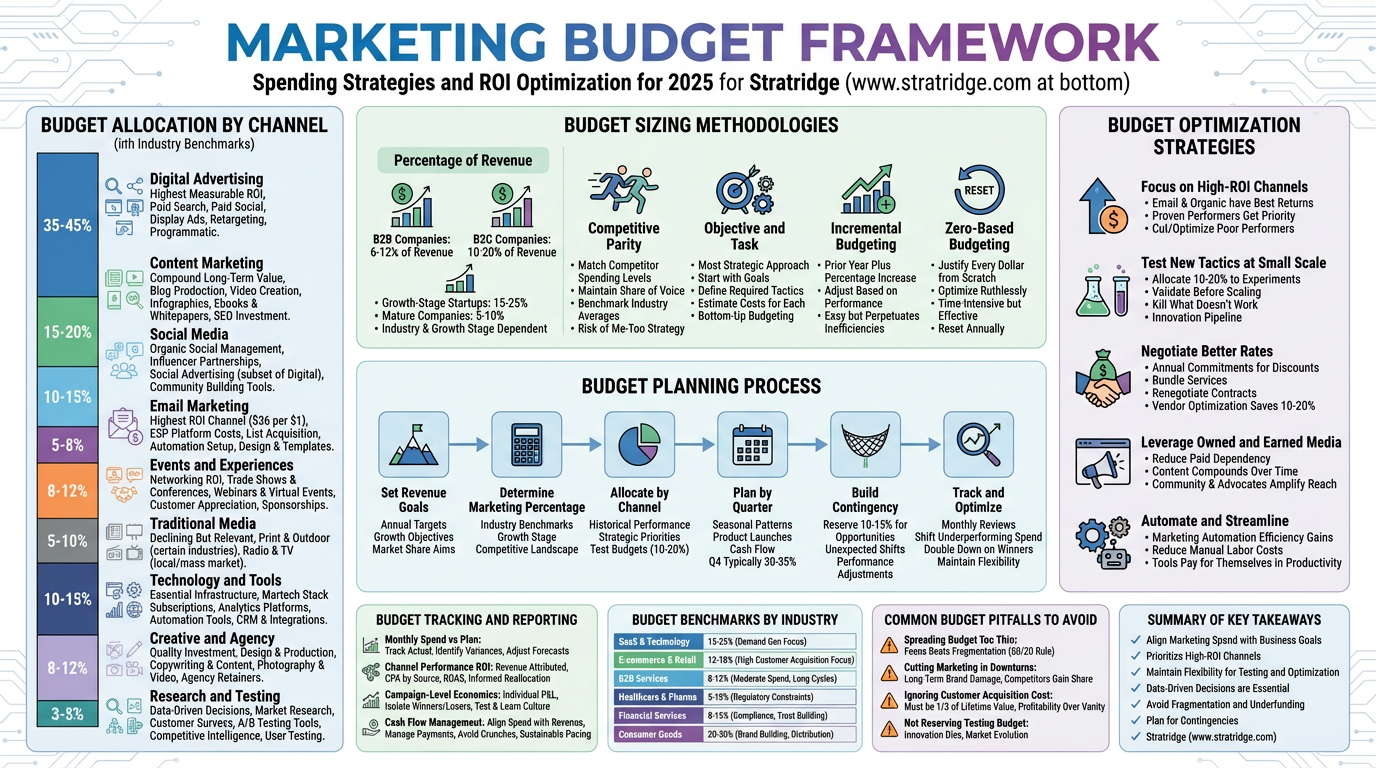
For B2B SaaS CMOs, the annual planning cycle often begins with a revenue target and ends with a marketing budget and headcount allocation. The critical challenge lies in bridging the gap between these two points with precision and defensibility. Without a robust framework, resource planning can devolve into guesswork, leading to either under-resourcing and missed targets or over-investment and inefficient spend. This guide outlines a systematic approach to model marketing headcount and program spend directly against pipeline targets, ensuring every resource is aligned with strategic revenue objectives.
The Disconnect: Revenue Goals vs. Marketing Resources
Many organizations struggle to establish a clear, quantitative link between top-line revenue aspirations and the granular marketing investments required to achieve them. This disconnect manifests in several ways: budgets are set based on historical spend plus a percentage increase, headcount is determined by perceived workload rather than pipeline contribution, and program investments lack a direct tie to conversion metrics. The result is often a reactive rather than proactive marketing function, constantly adjusting to shortfalls instead of systematically building towards success.
Effective marketing resource planning demands a paradigm shift from activity-based budgeting to outcome-based modeling. This involves understanding the fundamental drivers of pipeline generation and revenue conversion, and then working backward to determine the necessary inputs. It's not about how much you can spend, but how much you must spend to achieve a defined outcome.
Building Your Marketing Resource Model: A Step-by-Step Framework
Developing a robust marketing resource plan requires a structured, data-driven approach. This framework breaks down the process into actionable steps, moving from high-level revenue targets to specific headcount and budget allocations.
Step 1: Deconstructing the Revenue Target
The foundation of any resource plan is the revenue target. This isn't just a number; it's a commitment that marketing must translate into actionable pipeline goals. Work with your executive team to define marketing's specific contribution to new logo acquisition and expansion revenue. This clarity prevents misaligned expectations and ensures marketing's efforts are directly tied to the company's financial success.
Step 2: From Pipeline to Program Spend
Once the required pipeline value is established, the next step is to determine the marketing activities and associated spend necessary to generate that pipeline. This involves understanding your customer acquisition funnel and the cost drivers at each stage.
Consider your historical Cost Per MQL (CPMQL) and Cost Per SQL (CPSQL). These metrics are vital for projecting program spend. If your CPMQL is $100 and you need 10,000 MQLs, you're looking at $1,000,000 in program spend. This simple calculation provides a baseline, which can then be refined by considering different channels, campaign types, and target audiences.
Step 3: Modeling Headcount Against Operational Needs
Program spend addresses the 'what' of marketing, but headcount addresses the 'who' and 'how.' Translating MQL and program requirements into specific roles and team sizes is a nuanced process. It requires an understanding of team productivity, skill sets, and the strategic priorities of your marketing organization.
Consider the various functions within your marketing team: demand generation, content marketing, marketing operations, product marketing, and brand. Each function contributes to the overall pipeline goal, but with different resource requirements. For example, a significant increase in MQL volume might necessitate additional demand generation specialists, while a focus on thought leadership might require more content creators.
Headcount Modeling Considerations
It's also important to consider the ratio of program spend to headcount. While there's no universal ideal ratio, a significant imbalance can indicate inefficiencies. A marketing team with high headcount but low program spend might struggle to generate sufficient pipeline, while a team with high program spend but low headcount might lack the operational capacity to execute effectively or analyze results.
Sensitivity Analysis: Stress-Testing Your Plan
No plan is perfect, and market conditions, competitive landscapes, and internal performance can shift rapidly. This is where sensitivity analysis becomes invaluable. By systematically varying key assumptions, you can understand the resilience of your plan and identify critical thresholds.
This formula is a simplified representation; a comprehensive model will include various roles and their specific outputs.
What if your MQL-to-SQL conversion rate drops by 10%? What if your CPMQL increases by 15% due to rising ad costs? How does a change in average deal size impact your required pipeline? By modeling these scenarios, you can proactively develop contingency plans and understand the financial implications of different outcomes. This also provides a strong foundation for executive communication, demonstrating a thorough understanding of potential risks and opportunities.
This iterative process allows you to refine your assumptions and build a more robust, adaptable plan. It also highlights the most impactful levers you can pull to optimize your marketing performance. For instance, if a small improvement in MQL-to-SQL conversion significantly reduces required headcount, it might justify investing more in lead nurturing or sales enablement initiatives.
Integrating with Broader Strategic Planning
Marketing resource planning doesn't exist in a vacuum. It must be tightly integrated with the company's overall strategic planning, sales forecasting, and financial modeling. This ensures that marketing's plan is not just internally consistent but also externally aligned with the broader business objectives.
Consider how your marketing resource plan impacts other departments. For example, a significant increase in MQL volume will require sales to scale their capacity to handle the increased lead flow. Similarly, a shift in content strategy might require collaboration with product teams for technical accuracy. This cross-functional perspective is essential for a truly effective and integrated resource plan.
"The most effective marketing leaders don't just ask for budget; they build a data-driven case that demonstrates how every dollar and every hire directly contributes to the company's revenue goals."
For a deeper dive into executive communication strategies, particularly when presenting complex financial models, refer to our guide on Executive Briefing: Positioning for Board Deck. Understanding how to articulate the strategic value of your marketing investments is as crucial as the modeling itself.
Conclusion: From Guesswork to Precision
Marketing resource planning, when executed with precision, transforms the marketing function from a cost center into a strategic revenue driver. By systematically modeling headcount and program spend against pipeline targets, CMOs can move beyond reactive budgeting to proactive, data-driven investment. This approach not only ensures that resources are optimally allocated but also provides a clear, defensible narrative for marketing's contribution to the organization's financial success.
This level of planning empowers marketing leaders to make informed decisions, adapt to changing market dynamics, and confidently communicate the strategic value of their teams and initiatives. It's about building a marketing engine that is predictable, scalable, and directly aligned with the company's growth ambitions.
Stratridge provides the intelligence to not just plan, but to execute with confidence. Our platform offers the visibility to track your pipeline performance, the memory to analyze historical conversion rates, and the scan capabilities to benchmark your resource allocation against industry leaders. With Stratridge, you can transform your marketing resource planning from an annual headache into a strategic advantage, ensuring every investment drives measurable revenue impact.
Keep reading
Strategic Context for Investor Updates
Most investor updates are metrics reports without strategic context — and investors forget the reasoning even when they retain the numbers. The three sections that make updates substantive without lengthening them.
Executive Summary: Positioning Audit Results for the Board
A one-page board template for reporting positioning audit findings, with the structure CFOs and independents actually read before the meeting
The ROI of Positioning: How to Measure What You Can't Directly Attribute
Positioning ROI can't be traced to a single campaign or deal — it shows up in every metric at once. The five measurement approaches that actually hold up to a CFO's scrutiny, and the one proxy that predicts the rest.
Positioning Audit
Find out exactly where your positioning is losing buyers.
Run an eight-area diagnostic of your site against your own strategic intent. Stratridge reads your pages, compares them to your positioning goals, and surfaces the specific gaps costing you deals — with a prioritized action plan.
- ✓Eight-lens diagnostic in under two minutes
- ✓Evidence pulled directly from your own site
- ✓Prioritized action plan, not a generic checklist