For Series B-C SaaS companies, the marketing budget is not merely an expense; it's a strategic lever for scaling. Yet, many CMOs grapple with the perennial challenge of optimal allocation. How do you split resources effectively across demand generation, brand building, product marketing, and operational infrastructure when growth targets are aggressive and every dollar counts? The answer lies not in intuition, but in a data-driven model that adapts to your current stage and future ambitions.
The Strategic Imperative of Budget Allocation
Misaligned marketing spend can stifle growth, erode ROI, and create internal friction. In the Series B-C phase, where companies are moving beyond product-market fit to sustained, repeatable growth, the stakes are particularly high. A robust budget allocation model provides clarity, accountability, and a framework for continuous optimization. It moves the conversation from 'what did we spend?' to 'what did we achieve, and how can we do better?'
This model is designed to help CMOs navigate the complexities of scaling, ensuring that investments in marketing directly support the overarching business objectives. It acknowledges that the optimal mix shifts as the company matures and reaches new ARR milestones.
Core Components of the Marketing Budget
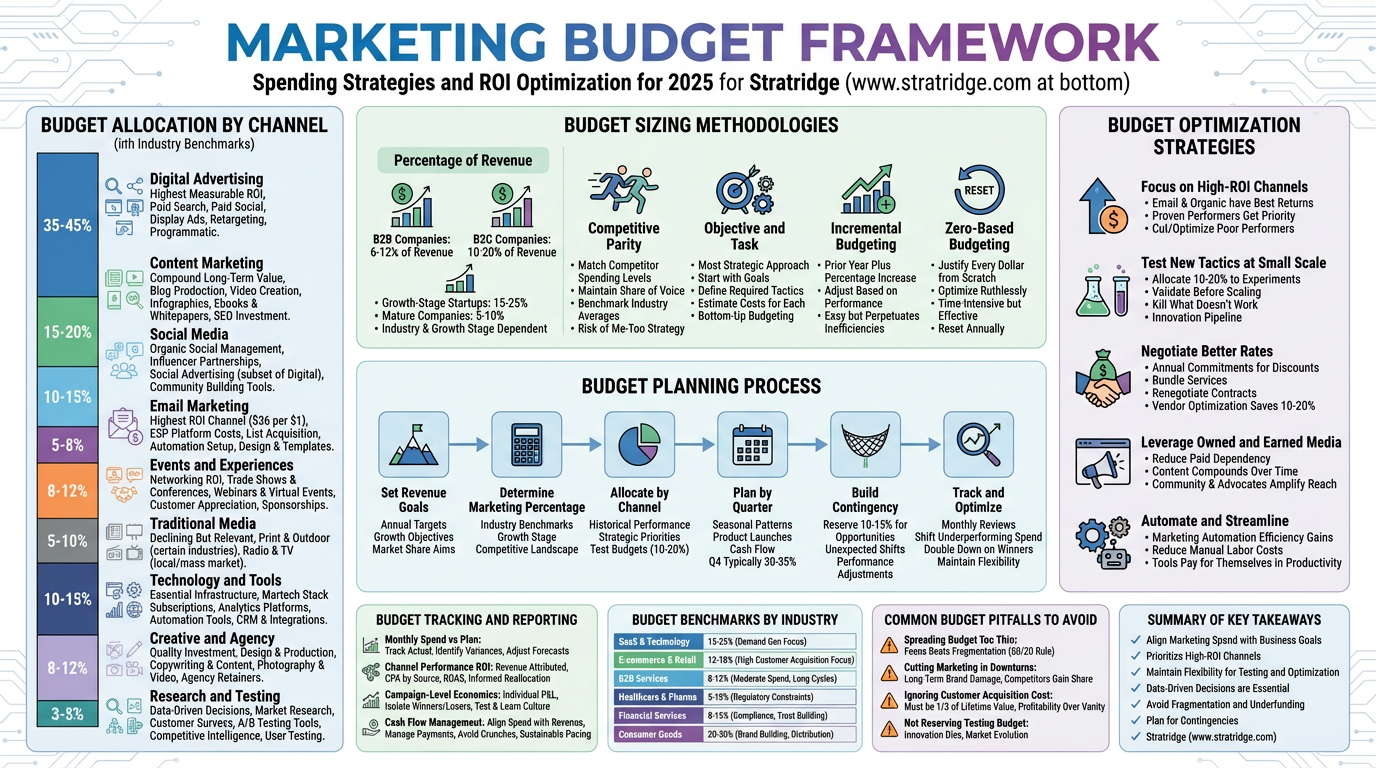
Before allocating, it's crucial to define the primary buckets of marketing spend. While specific line items will vary, most B2B SaaS marketing budgets can be categorized into four core areas:
- Demand Generation (Demand Gen): Activities focused on generating leads and pipeline. This includes paid advertising (SEM, social, display), content syndication, webinars, email marketing, and sales enablement content.
- Brand & Awareness: Investments in building brand equity, thought leadership, and market presence. This encompasses PR, analyst relations, organic social media, brand campaigns, and corporate events.
- Product Marketing: Activities that drive product adoption, usage, and expansion. This includes messaging, positioning, sales collateral, competitive intelligence, and launch support.
- Marketing Operations (Marketing Ops): The infrastructure, technology, and people that enable the other functions. This covers marketing automation platforms, CRM integration, analytics tools, data management, and team salaries.
Budget Allocation by ARR Threshold
The ideal allocation percentage for each component is dynamic, evolving with the company's Annual Recurring Revenue (ARR). A company at $10M ARR has different priorities and capabilities than one at $50M ARR. Here, we outline benchmark ranges and decision trees for key ARR thresholds.
$10M - $25M ARR: Focus on Repeatable Demand & Foundational Brand
At this stage, the emphasis is on solidifying repeatable demand generation channels and establishing a clear brand identity. Marketing ops should be building out core infrastructure.
Decision Tree Considerations:
- If CAC is rising: Invest more in brand and organic channels to reduce reliance on paid. Review product marketing's sales enablement effectiveness.
- If pipeline velocity is slow: Double down on demand gen optimization and lead scoring within marketing ops.
- If sales struggle with messaging: Prioritize product marketing resources for clearer value propositions and battle cards.
$25M - $50M ARR: Scale & Diversify Channels, Elevate Brand, Optimize Ops
As ARR grows, the focus shifts to scaling successful channels, diversifying into new ones, and elevating brand presence. Marketing ops becomes critical for efficiency and advanced analytics.
Decision Tree Considerations:
- If new market entry: Allocate more to brand and product marketing for localized messaging and awareness.
- If churn is a concern: Increase product marketing's focus on customer marketing and adoption programs.
- If data insights are lacking: Invest heavily in marketing ops for advanced analytics and data science capabilities.
$50M+ ARR: Market Leadership, Innovation, and Efficiency
At this scale, the goal is often market leadership, continuous innovation, and maximizing operational efficiency. Brand becomes a significant competitive differentiator.
Decision Tree Considerations:
- If competitive pressure is intense: Prioritize brand and product marketing for differentiation and thought leadership.
- If global expansion: Significant investment in demand gen and product marketing for regional adaptation.
- If seeking operational leverage: Focus marketing ops on AI/ML tools and process automation.
Dynamic Allocation and Continuous Optimization
This model is not static. It requires continuous monitoring, analysis, and adjustment. The CMO's role is to act as the architect of this dynamic system, leveraging data to inform decisions and adapt to market shifts. Regular budget reviews, performance analysis, and scenario planning are essential.
This formula provides a directional guide; qualitative factors and strategic imperatives must also be considered.
Consider how your budget allocation impacts your complete positioning audit framework and your ability to build battle cards sales actually uses.
Implementing the Model: A Step-by-Step Guide
Implementing a data-driven budget allocation model requires a structured approach. It's not a one-time exercise but an ongoing process of refinement.
This iterative process ensures that your marketing budget remains a dynamic asset, always aligned with your strategic objectives and optimized for maximum impact. It's about building a revenue architecture that supports sustainable growth.
This template, powered by Stratridge's intelligence, provides the practical tools to implement the data-driven budget allocation model discussed. It allows CMOs to move beyond guesswork, enabling precise, strategic investments that directly contribute to growth and market leadership. Leverage Stratridge to scan your current marketing operations, identify inefficiencies, and launch more effective campaigns with clear visibility into ROI.
Keep reading
Executive Summary: Positioning Audit Results for the Board
A one-page board template for reporting positioning audit findings, with the structure CFOs and independents actually read before the meeting
Strategic Context for Investor Updates
Most investor updates are metrics reports without strategic context — and investors forget the reasoning even when they retain the numbers. The three sections that make updates substantive without lengthening them.
Executive Briefing: Positioning for the Board Deck
How to explain positioning to a board — the four slides that matter, the metrics to pair with each, and the reason most positioning slides get skipped in the read-ahead.
Positioning Audit
Find out exactly where your positioning is losing buyers.
Run an eight-area diagnostic of your site against your own strategic intent. Stratridge reads your pages, compares them to your positioning goals, and surfaces the specific gaps costing you deals — with a prioritized action plan.
- ✓Eight-lens diagnostic in under two minutes
- ✓Evidence pulled directly from your own site
- ✓Prioritized action plan, not a generic checklist