Marketing Psychology Principles
Seven cognitive biases that actually move B2B buyers — and three your competitors are already using against you.
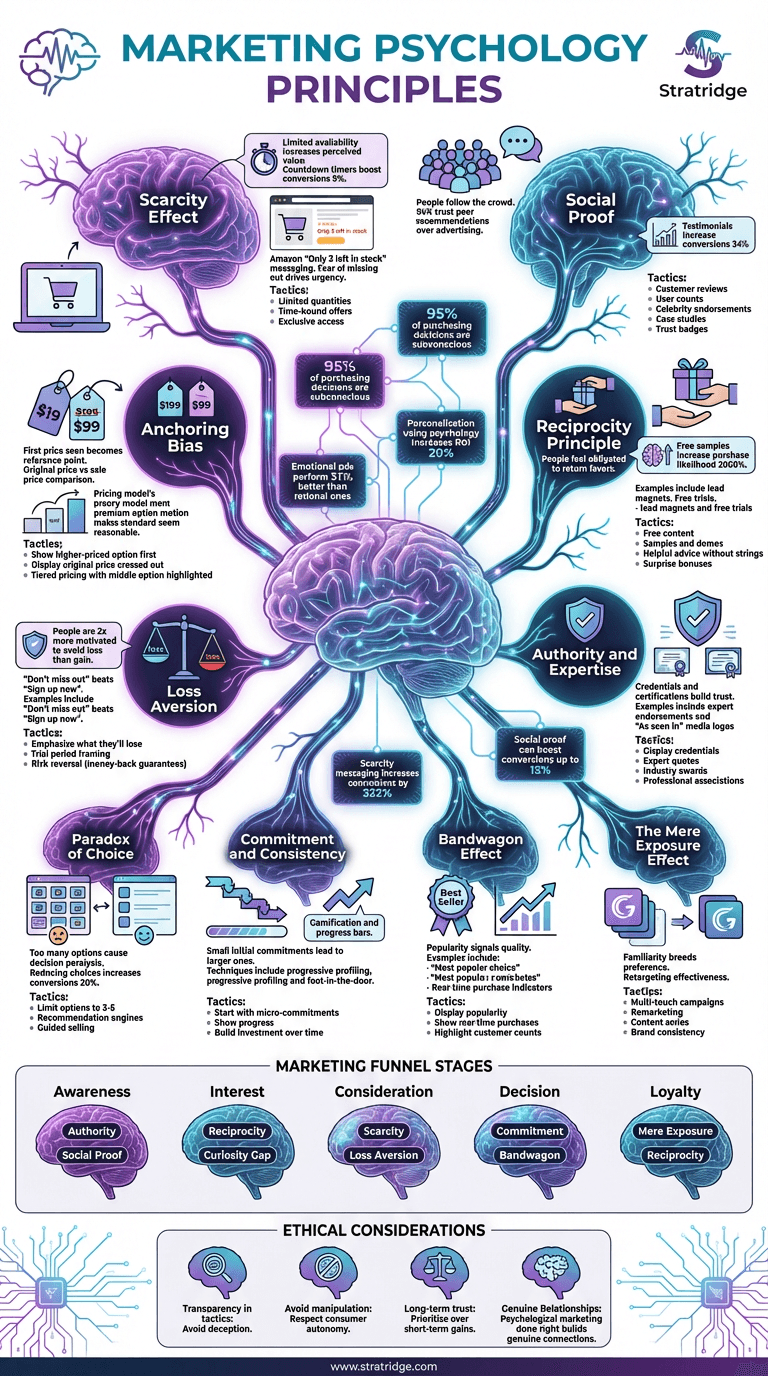
What this infographic is actually arguing.
Every marketer has read about cognitive biases. Most apply them as party tricks — scarcity countdowns, fake social proof, urgency-in-all-caps — which works for impulse B2C and backfires in B2B. This infographic covers the seven psychological principles that actually move committee buyers making considered purchases, and the three your competitors are already exploiting whether you name them or not.
Social proof is the most-used and most-diluted. Logo walls work; curated testimonials don't; case studies with named buyers and named outcomes work best. The principle is specificity: the brain discounts generic validation and rewards specific, verifiable, identifiable proof. A named CFO saying "we cut acquisition cost 34%" is social proof. A stock-photo testimonial from "Jane M." is noise.
Loss aversion moves B2B buyers more reliably than gain framing. "Here's what you'll save" underperforms "Here's what you're losing right now." Not because buyers are pessimists but because status-quo inertia is real and the work of changing systems costs political capital. Loss framing clears that hurdle.
Anchoring shapes the pricing conversation whether you plant the anchor or let competitors do it. If you don't publish a price, a reference, or a category benchmark, the buyer builds their own anchor from whoever else is in the evaluation — usually not you.
The three your competitors are using on you: authority (category reports, analyst mentions, research citations), commitment and consistency (free trials that become sunk-cost psychology), and the contrast principle (a "good-better-best" pricing table where the middle option is the one you're supposed to pick).
What doesn't work in B2B: urgency timers on SaaS pricing pages (insults the buyer's intelligence), fake scarcity ("only 3 seats left"), and artificial exclusivity gates that the buyer can see through. The committee buyer has seen every trick twice. Running them damages trust faster than the conversion lift earns back.
The working principle underneath all of this: psychology is a force multiplier on a message that's already true. Deployed on a weak claim, it reads as manipulation. Deployed on a strong claim, it earns attention the claim had already earned.
Stratridge's Message Consistency audit flags the most common B2B failure mode: psychology tactics without underlying claim strength.
Foundational Marketing
The Marketing Funnel Explained
The five funnel stages, what each one actually moves, and where most B2B teams leak.
SEO Best Practices
On-page, technical, and off-page fundamentals — the SEO checklist that still compounds.
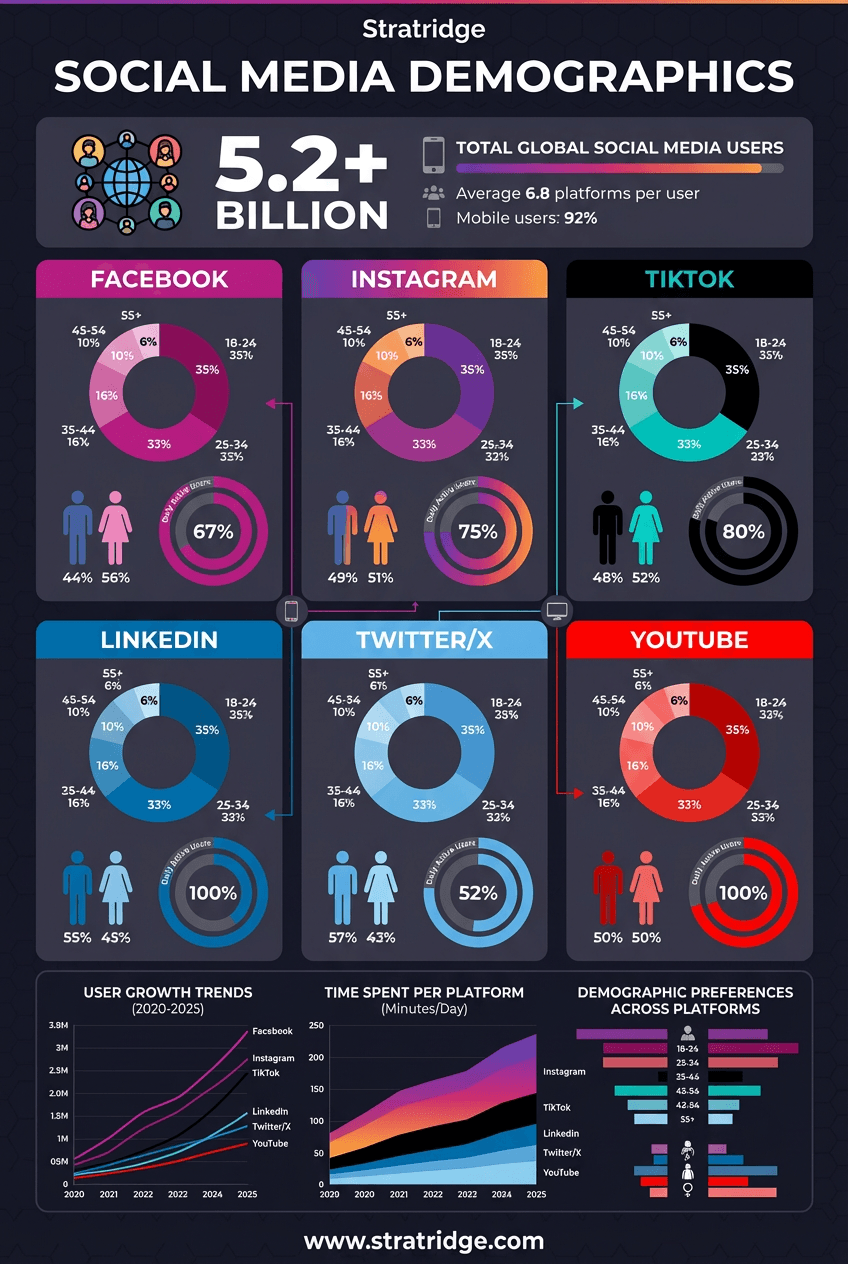
Social Media Demographics
Who is actually on each platform in 2025 — and the decision it forces on your channel mix.
This infographic is free. The audit is too.
Paste your URL and Stratridge returns an audit graded against the six dimensions and twenty-four factors — so you see where the story on your site lines up with the story this infographic describes, and where it doesn't.