For vertical SaaS companies, the initial promise is clear: deep specialization for a specific industry, leading to rapid adoption and undeniable product-market fit. Yet, as growth accelerates, many founders face a critical juncture. The very niche that fueled early success can become a ceiling, limiting total addressable market and stifling further expansion. The challenge isn't merely about finding new customers; it's about strategically redefining your market without diluting your core value proposition or confusing your hard-won positioning. This guide explores how leading vertical SaaS players have navigated this expansion, offering frameworks to identify opportunities and maintain clarity.
The Niche Paradox: When Specialization Becomes a Constraint
Vertical SaaS thrives on solving acute, industry-specific problems. This focus allows for tailored features, domain expertise, and a sales motion that speaks directly to a niche's pain points. However, the inherent limitation of a niche is its size. Eventually, the most accessible segments are saturated, and growth rates inevitably slow. The paradox emerges when the desire for continued growth clashes with the foundational positioning built on narrow specialization. Expanding carelessly risks becoming a "horizontal solution with vertical features" – a death knell for clear market positioning.
Consider the early days of a construction management software. Its initial success came from deeply understanding the workflows of residential contractors. But to grow, it needed to serve commercial builders, then perhaps infrastructure projects. Each expansion required careful consideration of whether the core product and messaging could stretch, or if new, distinct positioning was required. This isn't just about adding features; it's about understanding how different segments perceive value and how your solution fits into their operational reality.
Framework for Market Definition Expansion
Expanding your market definition requires a structured approach, moving beyond instinct to data-driven strategy. This framework helps identify adjacent opportunities and assess their strategic fit.
This methodical approach prevents the common pitfall of simply chasing revenue without a clear strategic rationale. Each step is designed to ensure that expansion is deliberate and reinforces, rather than dilutes, your market standing.
Case Study: From Restaurant POS to Hospitality OS
Consider a vertical SaaS company that began as a point-of-sale (POS) system exclusively for fine dining restaurants. Their deep understanding of menu management, table-side ordering, and sommelier tools gave them an edge. As they matured, they recognized the limitations of this narrow focus. The strategic question became: how to expand without becoming just another generic POS?
Their expansion strategy involved two key moves:
- Adjacent Vertical Expansion: They identified hotels, catering companies, and event venues as adjacent markets. These shared core needs (inventory, staff management, payment processing) but had distinct operational nuances (e.g., hotel room service vs. restaurant dining). They leveraged their existing POS engine but built modular extensions for hotel front desks and event booking.
- Solution Breadth Expansion: Beyond POS, they developed modules for workforce management, supply chain optimization, and customer relationship management, transforming into a comprehensive "Hospitality Operating System." This allowed them to capture more wallet share and become a mission-critical platform.
Crucially, they maintained distinct messaging for each segment while unifying their brand under the broader "Hospitality OS" umbrella. This allowed them to expand their market definition from "fine dining POS" to "integrated hospitality management platform" without losing their reputation for deep industry expertise.
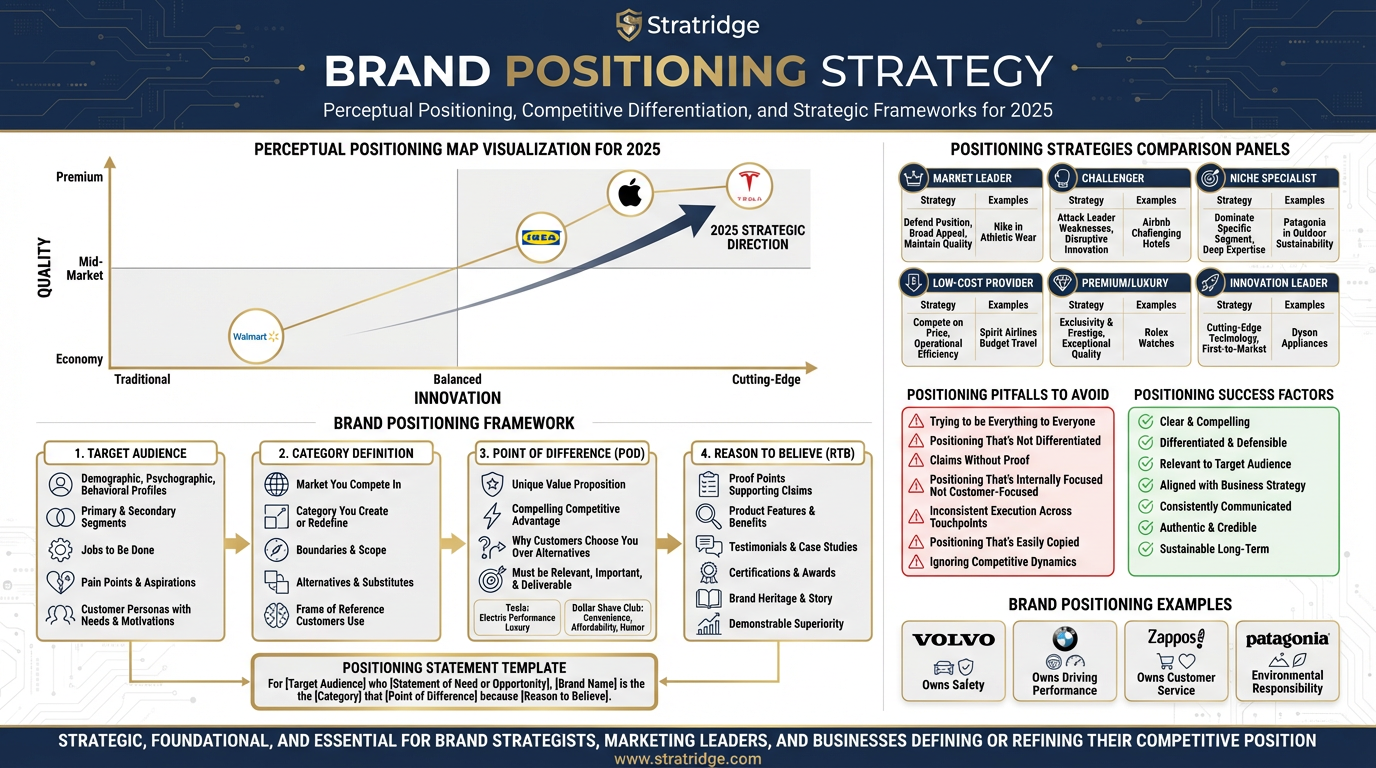
Maintaining Positioning Clarity During Expansion
One of the greatest risks in market expansion is the erosion of positioning clarity. When you try to be everything to everyone, you often become nothing to anyone. Stratridge's approach emphasizes a continuous "positioning audit" throughout the expansion process.
Key considerations for maintaining clarity:
- Segment-Specific Messaging: While your core product might serve multiple verticals, your marketing and sales narratives must be tailored. A construction project manager needs to hear different benefits than a commercial real estate developer.
- Feature Prioritization: Resist the urge to build every feature for every new segment. Prioritize features that offer the highest leverage across segments or create a distinct advantage in a new, high-value vertical.
- Sales Enablement: Equip your sales teams with the tools and training to articulate your value proposition effectively in each new market. Generic sales decks will fail.
- Competitive Differentiation: As you expand, your competitive set will change. Continuously monitor new competitors and refine your competitive differentiation to highlight what makes you uniquely valuable.
The Role of Strategic Context in Expansion
Successful market expansion isn't just about tactical execution; it's about establishing a clear strategic context that guides all decisions. This involves defining the 'why' behind the expansion, the desired future state, and the guardrails to prevent scope creep.
Strategic Context Checklist for Market Expansion
Without this foundational strategic context, expansion efforts can quickly become fragmented, leading to wasted resources and a muddled market identity. It's about making deliberate choices, not just opportunistic moves.
Conclusion: Expanding with Purpose and Precision
For vertical SaaS companies, the journey from niche to category leader is a testament to strategic foresight and disciplined execution. It's not about abandoning your roots but about intelligently extending your reach. By systematically identifying adjacent markets, validating pain points, and meticulously crafting differentiated positioning, you can expand your market definition without sacrificing the clarity that made you successful in the first place. This requires a continuous feedback loop, leveraging insights from your positioning audit and competitive intelligence to refine your approach.
Stratridge provides the intelligence and frameworks necessary to navigate these complex market expansions. Our platform helps B2B SaaS leaders conduct comprehensive positioning audits, analyze competitive landscapes, and develop clear go-to-market strategies that enable purposeful growth.
Keep reading
The Positioning Pivot: When to Change Your Category Entirely
Most positioning problems can be solved with a refresh. A small minority require a pivot — changing the category itself. Here's the five signals that tell you which you're facing, and the 12-month execution plan when pivot is the answer.
When to Refresh Your Positioning (Not Just Your Messaging)
How to tell whether the problem is positioning or execution — the four signals that mean the thesis is wrong, not the copy.
Competitive Differentiation When Your Product Is Mostly the Same
Product parity is the norm in mature categories, not the exception. The teams that win from parity do it on four differentiator types that aren't in the product — and they name which one on purpose.
Positioning Audit
Find out exactly where your positioning is losing buyers.
Run an eight-area diagnostic of your site against your own strategic intent. Stratridge reads your pages, compares them to your positioning goals, and surfaces the specific gaps costing you deals — with a prioritized action plan.
- ✓Eight-lens diagnostic in under two minutes
- ✓Evidence pulled directly from your own site
- ✓Prioritized action plan, not a generic checklist