Viral Marketing Mechanics
Why "viral" rarely scales on command — and the three mechanics that actually compound.
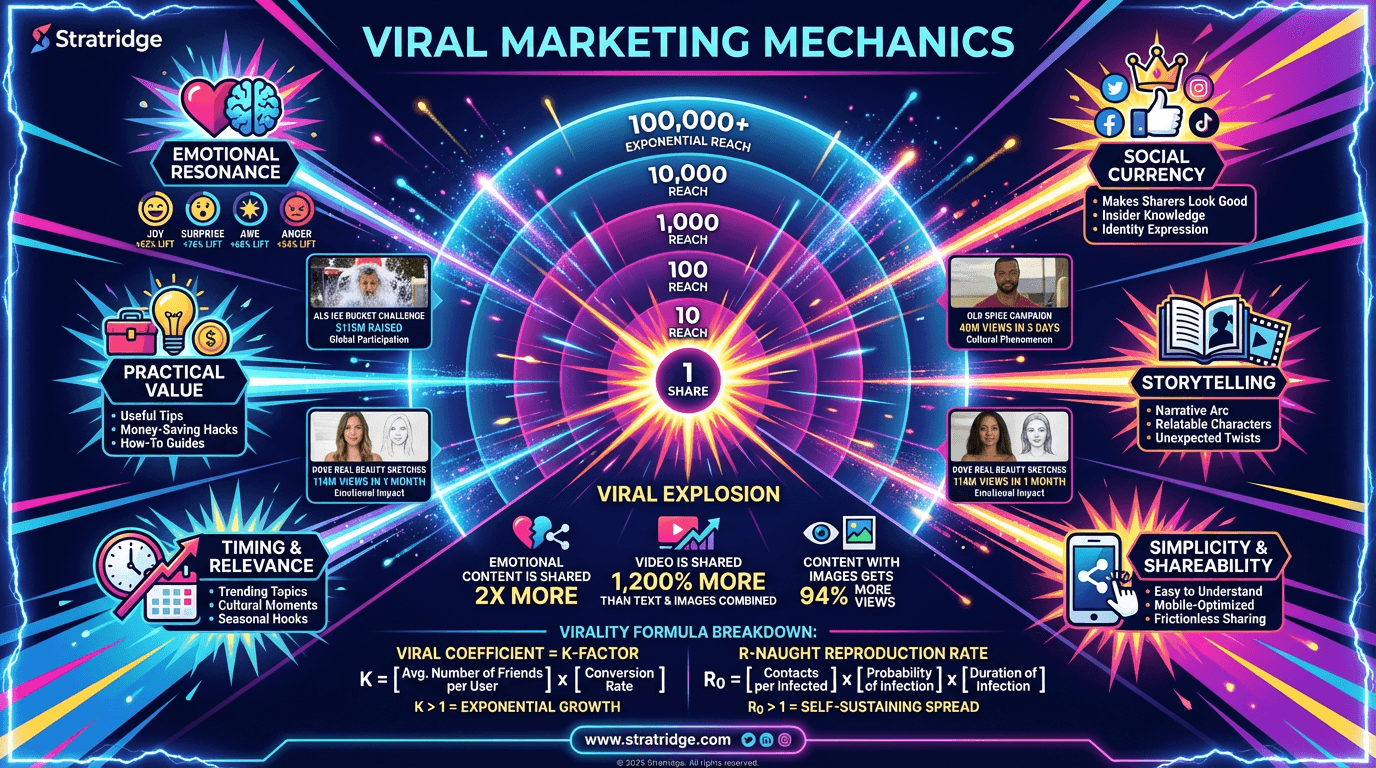
What this infographic is actually arguing.
"Viral marketing" is one of the most-promised and least-delivered outcomes in marketing. Every agency pitch deck describes the campaign that will "go viral." Almost none of them do, because virality is a property that emerges from specific mechanics, not an outcome you can direct. This infographic covers what the underlying mechanics actually are and why the "go viral" framing misleads teams into campaigns that can't compound.
The first correction: virality is a coefficient, not an event. A piece of content with a K-factor above 1 (each viewer produces more than one additional viewer) spreads. Below 1, it doesn't, regardless of how clever or well-produced it is. The question isn't "how do we make it go viral?" — it's "what makes this content have K-factor above 1?" Almost nothing does, and the content that does usually does so by accident.
The three mechanics that produce real viral compounding. First: product virality. The product itself is easier to use or more valuable when others are using it — classic network effects plus in-product invitation flows. Dropbox's "refer a friend for more storage" is the textbook example and still works in B2B products with collaboration use cases. This compounds because the spread is embedded in the product, not in the marketing.
Second: tool-based virality. A free tool that produces shareable output — a calculator, a generator, a teardown — where the shared output naturally reveals the tool. The "Which Warren Buffett Letter Are You?" quiz is not a tool; the "Run Your Company's Carbon Footprint Calculator" is. Shareable because the output is useful to share, and the tool is visible because the output references it. Stratridge's free Positioning Audit operates on this mechanic — the output is useful enough to share and the origin is visible in the output.
Third: narrative virality. A genuinely fresh take on a contested topic, shared because the take is new, not because the brand is. This is the hardest to manufacture because the novelty has to be real. Most attempts produce warmed-over takes in a "hot take" register, which reads as branded content and doesn't spread.
What doesn't compound: funny one-off campaigns, pop-culture tie-ins, stunts, and anything built around a social-media hook rather than an underlying utility or argument. These produce spikes without compounding.
The sustainable move: build the mechanic into the product or the tool, not into the campaign.
This infographic is free. The audit is too.
Paste your URL and Stratridge returns an audit graded against the six dimensions and twenty-four factors — so you see where the story on your site lines up with the story this infographic describes, and where it doesn't.