Social Listening Strategy
What social listening is actually good at — and the sentiment-score illusion most teams optimize around.
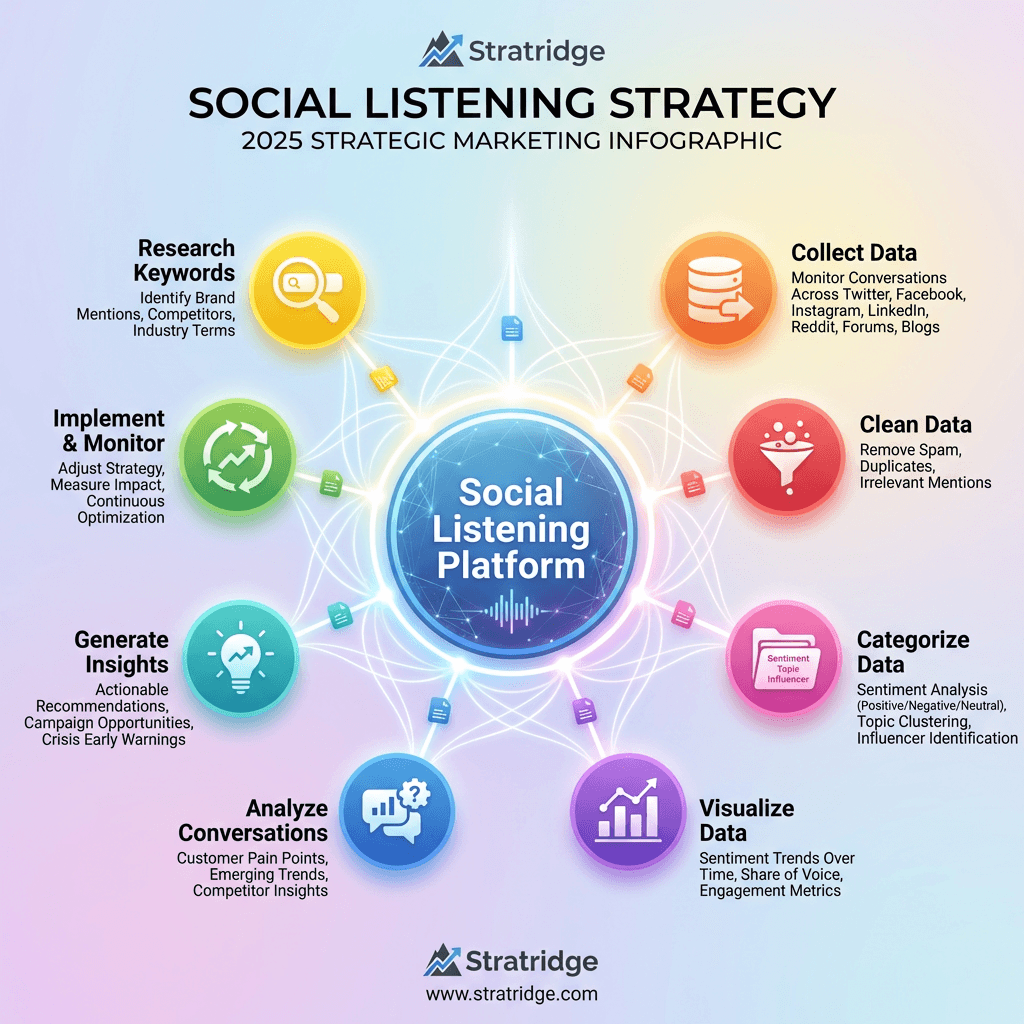
What this infographic is actually arguing.
Social listening is sold as a crystal ball into what customers think. In practice, it's a specific research tool that's good at specific jobs and poor at others. Teams that deploy it for what it's good at extract real value; teams that chase sentiment scores and vanity dashboards get expensive noise. This infographic covers both sides.
What social listening is actually good at. First: finding the language your buyers actually use. If buyers describe your category with different words than you do, you'll never rank and you'll never convert. Social listening surfaces those terms in real contexts — forum threads, LinkedIn posts, podcast transcripts — and feeds them into messaging, SEO, and ad copy. This is the single highest-ROI use of the tooling.
Second: early warning on reputation issues. A thread on Reddit or a post on LinkedIn that starts gaining traction about your product can be caught while it's small if you're listening. Waiting for it to show up in Google search results is waiting too long. This is where response speed compounds — hours matter.
Third: competitive intelligence. What are customers saying about competitors' products in places competitors can't control? Review sites, community forums, conference back-channels. These are primary-source signals that slide decks and vendor content won't give you.
Fourth: community discovery. Finding where your buyers are actually talking to each other — which is rarely where your marketing team assumes. Those are the platforms to earn presence on, not to advertise on.
What social listening is poor at: sentiment scoring at the brand level. The algorithmic sentiment score your tool produces is a composite of enough different signals, weighted in enough opaque ways, that it rarely reflects the thing you care about. A brand with a "+72 sentiment" quarter and a brand with "+68" didn't have meaningfully different quarters; they had two different noise readings. Stop reporting on it. Track specific incidents instead.
The illusion most teams optimize around: dashboard mentions. A dashboard that goes up and to the right on mention volume rewards whatever behavior produces more mentions, regardless of whether those mentions reflect real awareness gain. A controversial product misstep generates more mentions than a successful launch. Volume is not value.
Use social listening as a research input, not a reporting metric.
Audience & Metrics
This infographic is free. The audit is too.
Paste your URL and Stratridge returns an audit graded against the six dimensions and twenty-four factors — so you see where the story on your site lines up with the story this infographic describes, and where it doesn't.