Guerrilla Marketing Tactics
What guerrilla marketing means for B2B — and the three tactics that beat a six-figure media budget.
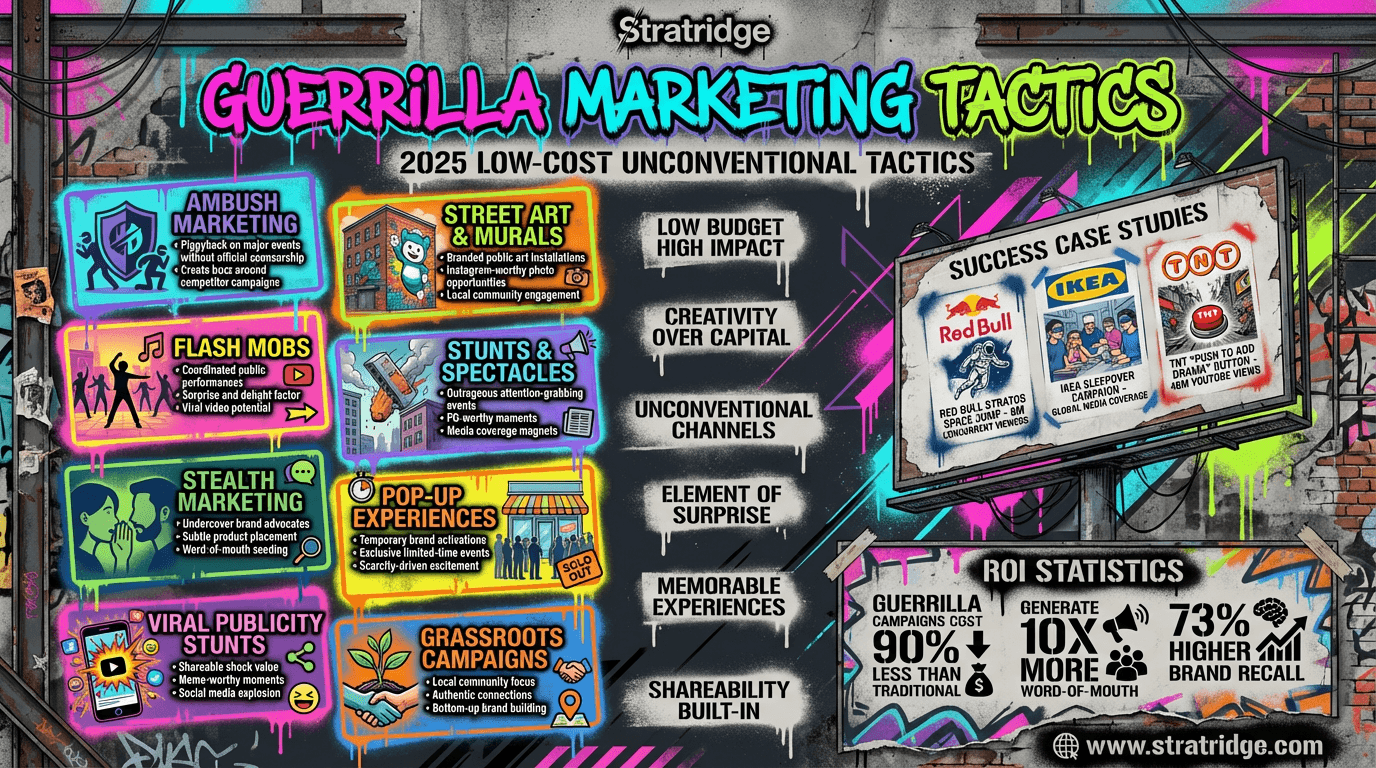
What this infographic is actually arguing.
Guerrilla marketing has a consumer-brand origin (wheat-pasted posters, street stunts, surprise product drops) that doesn't translate directly to B2B. The underlying principle — outsized attention from modest budget through creative execution — does translate, and B2B teams that internalize the principle consistently outperform teams with 10× the budget running conventional campaigns. This infographic covers what guerrilla actually means in B2B and the three tactics that beat a six-figure media budget.
The principle: identify where your target buyer's attention is under-contested and show up there in a way competitors haven't. The contested channels — LinkedIn feed ads, Google search, retargeting display — are expensive because they're obvious. The uncontested channels are almost always where the craft lives.
The three tactics that consistently outperform. First: original research with aggressive distribution. A survey of 500 practitioners on a pointed question in your category — not a generic "state of marketing" report, a specific question that produces a sharp finding — distributed to the industry media that covers your category, produces more inbound interest than any paid campaign in the same budget range. The research has to have a real finding; safe, hedged reports don't compound.
Second: public teardowns of public artifacts. Annotate a real competitor's homepage, a real campaign, a real analyst report, with your point of view. Publish it. This works because it shows thinking in public, compares favorably to most of the competitive content in B2B (which is polished and substance-free), and gets shared by people who disagree as well as people who agree. Stratridge's Anatomy of a Repositioning teardown is built on this mechanic.
Third: deeply practitioner-useful free tools. Not gated lead magnets. Actual free utilities that practitioners use and send to peers — an interactive calculator, a template that saves hours, a benchmark dataset. Practitioners are underserved in B2B marketing (most free resources are disguised lead gen); a genuinely useful free tool creates durable reputation.
What doesn't work in B2B guerrilla: street stunts (wrong audience), viral videos (rarely work in committee-buying contexts), PR stunts (the cycle is shorter than the sales cycle). The underlying pattern: in B2B, guerrilla means substance-at-scale that competitors aren't willing to produce because it doesn't fit a brief.
The honest test: if your competitors wouldn't produce this, can't produce this, or won't produce this, it has guerrilla properties. If they could ship the same thing next quarter, it's just content.
Advanced Tactics
Account-Based Marketing
The three tiers of ABM, the tier most teams actually need, and the one they oversell to leadership.

Viral Marketing Mechanics
Why "viral" rarely scales on command — and the three mechanics that actually compound.
Neuromarketing Insights
What neuroscience research actually tells B2B marketers — versus the pop-neuroscience claims that don't replicate.
This infographic is free. The audit is too.
Paste your URL and Stratridge returns an audit graded against the six dimensions and twenty-four factors — so you see where the story on your site lines up with the story this infographic describes, and where it doesn't.