Understanding Google Algorithm Updates
How to read a Google update — and why the team chasing every patch loses to the team building durably.
What this infographic is actually arguing.
Google runs algorithm updates constantly. Most are invisible; some reshape rankings for entire industries; all of them generate an industrial complex of commentary that claims to decode them. This infographic is the literate reader's guide to algorithm updates — what they actually are, what they mean for your site, and why chasing every patch is the wrong posture.
Start with the taxonomy. Core updates (multi-week rollouts that affect broad quality signals) are the ones most likely to move a site's rankings meaningfully. Named updates (Helpful Content, Product Reviews, Spam updates) target specific quality problems and typically affect the sites most exposed to that specific problem. Minor updates (weekly tweaks to various ranking signals) are mostly noise at the site level.
The useful response to an update is diagnostic, not reactive. When rankings shift, the question isn't "what did the algorithm change?" — it's "what did this update reveal about my content that was already true?" Sites that drop in a Helpful Content update almost universally had content problems before the update. The update surfaced what was already there.
The posture that works: build for the signal the algorithm is actually measuring, which is usually "does this page help the person searching this query?" Reverse-engineered optimization (what keyword density, what entity graph, what schema markup) chases the tactical proxies Google uses to infer the underlying signal. Tactics decay; the underlying signal doesn't. Content that is genuinely helpful for a specific reader tends to keep ranking across algorithm changes, even when it loses some positions temporarily.
The anti-pattern that keeps failing: producing content to an algorithmic template, ranking briefly, and then getting caught by the next update. Teams in this pattern treat SEO as an arms race against Google, spend most of their budget on content that exists to rank rather than content that exists to be read, and end up on a treadmill where each update re-sets their library's performance.
The complicating factor in 2025: AI-generated content at scale has made "helpful content" harder for Google to distinguish on surface features alone. The algorithm increasingly weights brand signals, real-world reputation, and engagement metrics to separate authentic expertise from generated volume. Brands with real reputation benefit; brands relying on content-farm tactics don't.
Foundational Marketing
The Marketing Funnel Explained
The five funnel stages, what each one actually moves, and where most B2B teams leak.
SEO Best Practices
On-page, technical, and off-page fundamentals — the SEO checklist that still compounds.
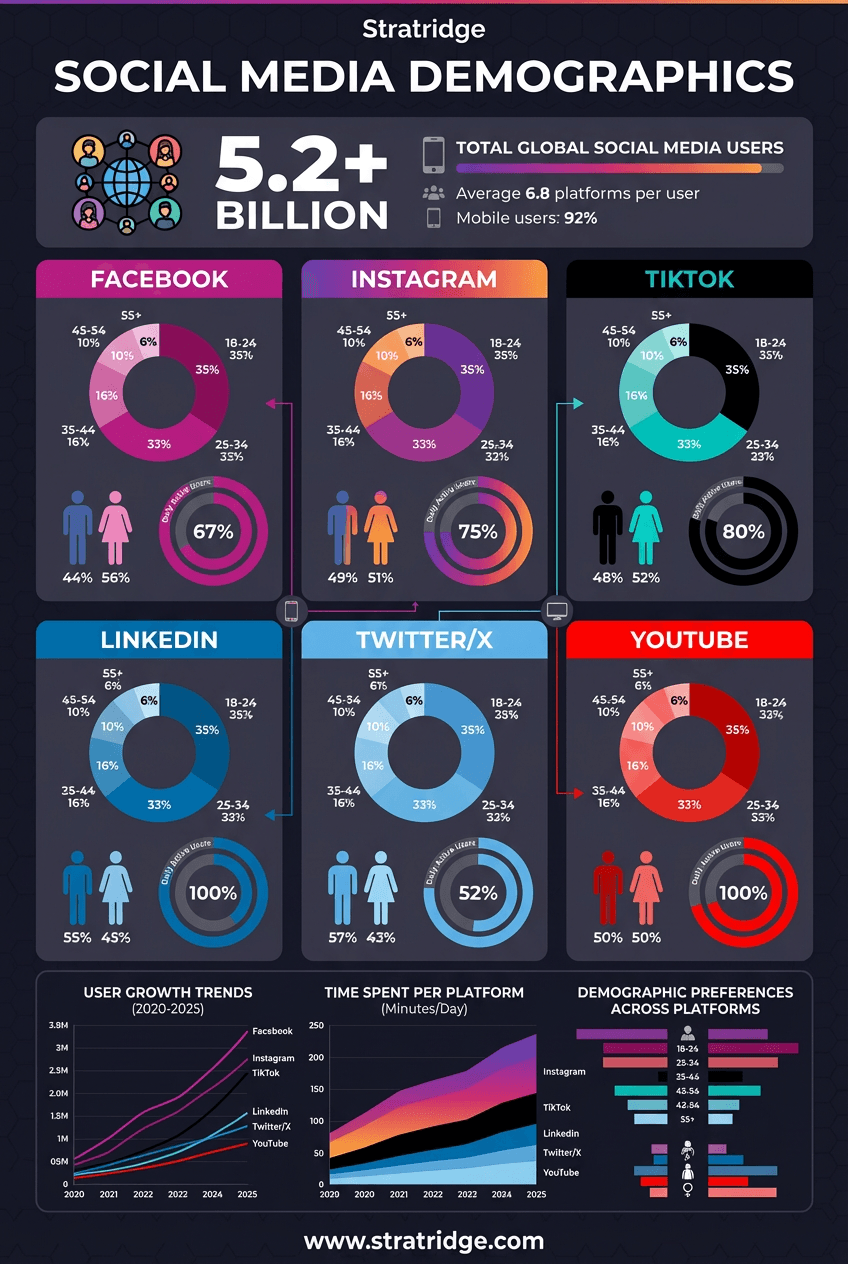
Social Media Demographics
Who is actually on each platform in 2025 — and the decision it forces on your channel mix.
This infographic is free. The audit is too.
Paste your URL and Stratridge returns an audit graded against the six dimensions and twenty-four factors — so you see where the story on your site lines up with the story this infographic describes, and where it doesn't.