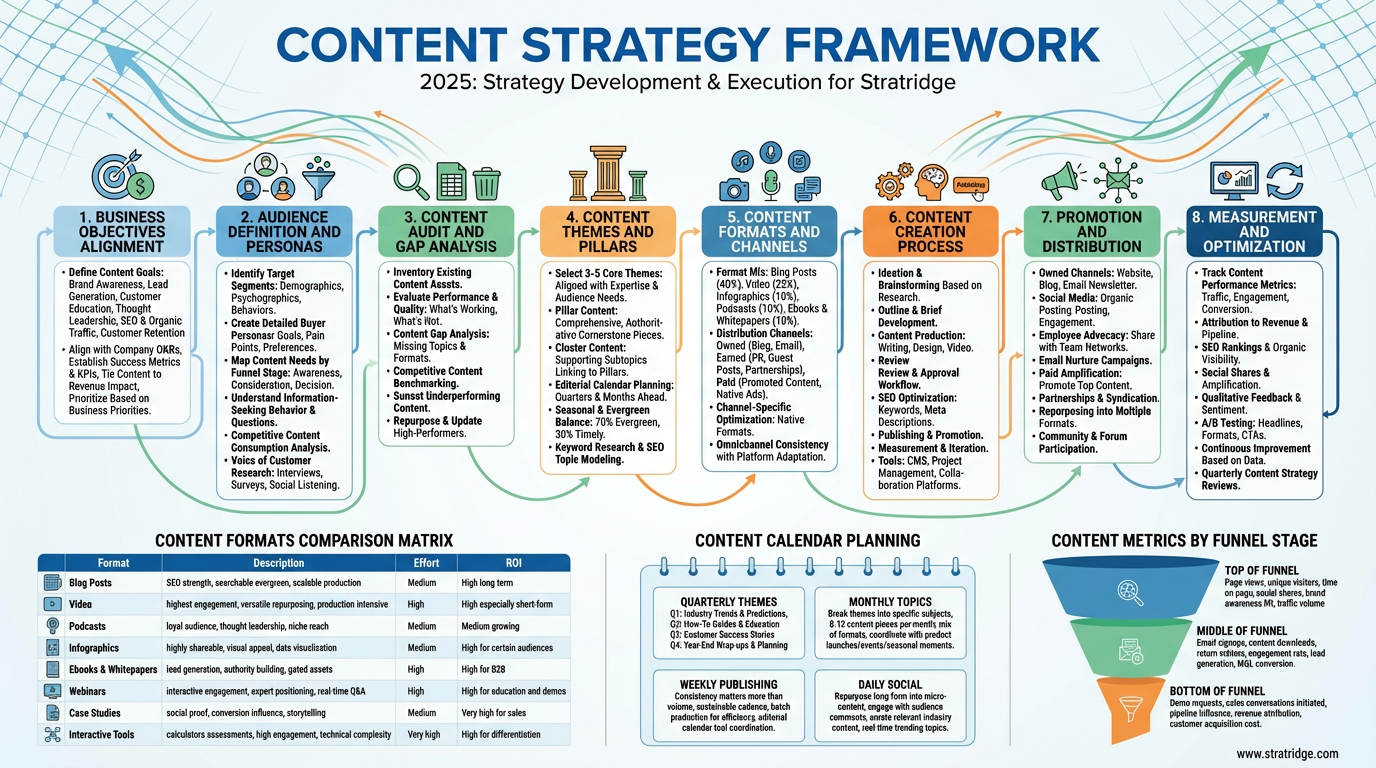
For B2B SaaS CMOs, the challenge isn't just creating content; it's orchestrating a content ecosystem that drives measurable business outcomes across the entire customer journey. Disconnected content efforts lead to wasted resources, fragmented messaging, and missed opportunities for both organic growth and sales acceleration. A well-defined content architecture is the strategic blueprint that ensures every piece of content serves a purpose, from attracting new prospects via search to empowering sales teams with the right assets at the right time.
The Strategic Imperative of Content Architecture
Content architecture is more than just an organizational chart for your blog posts. It's a strategic framework that dictates how your content is planned, created, distributed, and interconnected to achieve specific business objectives. In B2B SaaS, this means simultaneously optimizing for search engine visibility, nurturing leads through the demand funnel, and providing sales with the tools they need to close deals. Without a deliberate architecture, content often becomes a reactive, ad-hoc exercise, failing to deliver consistent value or impact.
This framework moves beyond simply generating articles to building a structured, interconnected knowledge base that acts as a perpetual asset for your business. It's about creating a system where content pieces reinforce each other, guiding the audience through a logical progression of understanding and engagement.
Pillar Pages: The Foundation of Your Content Universe
Pillar pages are comprehensive, high-value resources that cover a broad topic in depth. They serve as the authoritative hub for a specific subject area, providing a holistic overview and linking out to more detailed cluster content. For B2B SaaS, a pillar page might explore a core problem your software solves, a key industry trend, or a foundational concept related to your product category. Their primary role is to establish topical authority, attract organic search traffic for broad keywords, and serve as a central navigation point for users and search engines alike.
Key Characteristics of Effective Pillar Pages:
- Comprehensive: Covers all facets of a broad topic.
- Evergreen: Content remains relevant over a long period.
- Internal Linking Hub: Links to numerous related cluster content pieces.
- User-Centric: Designed to answer all primary questions a user might have about the topic.
- SEO Powerhouse: Targets broad, high-volume keywords.
Building effective pillar pages requires a deep understanding of your target audience's core challenges and the overarching themes relevant to your solution. It's not just about keyword stuffing; it's about providing genuine value and establishing your brand as a thought leader.
Cluster Content: Deep Dives and Specific Solutions
Cluster content, also known as topic clusters or sub-topics, are individual pieces of content that delve into specific aspects of the broader topic introduced by a pillar page. These can be blog posts, guides, case studies, webinars, or even tools. Each cluster piece links back to its central pillar page, reinforcing the pillar's authority and creating a robust internal linking structure. This interconnectedness signals to search engines the depth and breadth of your expertise on a given subject, improving the ranking potential of both the pillar and its associated clusters.
Examples of Cluster Content:
- Detailed how-to guides for specific features or processes.
- Comparative analyses of different approaches to a problem.
- Case studies demonstrating successful application of a concept.
- Interviews with subject matter experts.
- Glossaries of industry terms.
Optimizing Cluster Content for Impact
The synergy between pillar pages and cluster content is a powerful mechanism for dominating search results for a wide range of keywords, from broad industry terms to highly specific problem-solution queries. This structured approach ensures that no relevant search intent goes unaddressed.
The Editorial Calendar: Orchestrating Your Content Flow
While pillar and cluster content define the structural relationships, the editorial calendar provides the operational rhythm for content creation and publication. It's the strategic roadmap that ensures consistent output, aligns content with marketing campaigns, and allocates resources effectively. A well-managed editorial calendar goes beyond simply listing topics; it integrates keyword research, audience segmentation, content formats, distribution channels, and performance metrics.
Elements of a Strategic Editorial Calendar:
- Topic & Keyword Alignment: Maps content ideas to target keywords and pillar/cluster themes.
- Audience Focus: Ensures content addresses specific buyer personas and their journey stages.
- Content Type & Format: Plans for diverse content types (blogs, videos, whitepapers, etc.).
- Publication Schedule: Sets realistic deadlines and publication dates.
- Distribution Strategy: Outlines how content will be promoted across channels.
- Performance Metrics: Defines KPIs for each content piece and campaign.
An effective editorial calendar is a living document that adapts to market changes and performance insights. It's the central nervous system of your content operation, ensuring that every piece of content contributes to your overarching marketing and business objectives. For more on ensuring your messaging is consistent across all content, consider the insights in Seven Signs Your Messaging is Drifting.
Integrating Content Architecture with Demand Generation
Content architecture isn't just for SEO; it's a powerful engine for demand generation. By structuring your content around buyer needs and journey stages, you create natural pathways for prospects to discover, engage with, and convert through your content. Pillar pages attract top-of-funnel interest, while cluster content provides the detailed information needed for consideration. Gated content offers (e.g., whitepapers, templates) can be strategically placed within cluster content to capture leads, moving prospects further down the funnel.
Content Architecture's Role in Demand Gen:
- Lead Nurturing: Provides a logical sequence of content to educate and qualify leads.
- Conversion Optimization: Strategically places calls-to-action and gated assets.
- Personalization: Enables content recommendations based on user behavior and interests.
- Attribution: Makes it easier to track which content influences pipeline and revenue.
This integrated approach ensures that every content asset is not just informative, but also an active participant in your demand generation strategy, guiding prospects from initial awareness to qualified lead status. For a deeper dive into optimizing for modern search, refer to The CMO's Guide to LLM Optimization: From SEO to AIO.
Empowering Sales Enablement with Structured Content
Sales enablement is another critical beneficiary of a well-designed content architecture. Sales teams often struggle to find the right content at the right time to address prospect questions, overcome objections, or provide compelling evidence. A structured content hub, with clear categorization and interlinking, transforms your content library into a powerful sales asset. Pillar pages can serve as foundational training materials, while specific cluster content (e.g., case studies, competitive comparisons, ROI calculators) becomes readily accessible tools for sales conversations.
How Content Architecture Supports Sales:
- Easy Content Discovery: Sales reps can quickly find relevant assets.
- Consistent Messaging: Ensures sales uses approved, on-brand content.
- Objection Handling: Provides specific content to address common concerns.
- Deal Acceleration: Equips sales with compelling evidence and value propositions.
- Training & Onboarding: Pillar pages offer comprehensive overviews for new reps.
By proactively structuring content with sales needs in mind, you reduce friction in the sales process, improve sales productivity, and ultimately accelerate revenue growth. This strategic alignment ensures that your content investments pay dividends across the entire customer lifecycle. For more on preparing your sales team for product launches, see Product Launch Narrative Checklist: No Fluff.
Conclusion: Building a Future-Proof Content Ecosystem
Designing a robust content architecture is no longer optional for B2B SaaS CMOs; it's a strategic imperative. By consciously building out pillar pages, developing rich cluster content, and orchestrating it all with a dynamic editorial calendar, you create a content ecosystem that simultaneously optimizes for SEO, fuels demand generation, and empowers your sales force. This holistic approach ensures every content investment delivers maximum impact, transforming your content from a cost center into a powerful, self-sustaining growth engine.
Stratridge provides the intelligence and frameworks to help B2B SaaS leaders build and execute these sophisticated content strategies. Our platform offers diagnostic tools to assess your current content effectiveness and provides actionable insights to refine your architecture, ensuring your content investments directly translate into market leadership and accelerated revenue growth. Leverage Stratridge to transform your content strategy from a series of disconnected efforts into a cohesive, high-performing system.
Keep reading
7 Signs Your Messaging Is Drifting (And How to Catch It Early)
Messaging drifts the way codebases drift — each local change looks fine; the aggregate contradicts itself. Here are the seven patterns that appear first.
Product Launch Narrative Checklist (No Fluff)
A working checklist for pressure-testing a launch narrative before it ships, so the announcement doesn't read like every other launch on the same Tuesday
The CMO's Guide to LLM Optimization: From SEO to AIO
A strategic framework for marketing leaders to reallocate search investment as AI search engines become primary discovery channels, covering citation mechanics, structured data, and AI visibility measurement.
Positioning Audit
Find out exactly where your positioning is losing buyers.
Run an eight-area diagnostic of your site against your own strategic intent. Stratridge reads your pages, compares them to your positioning goals, and surfaces the specific gaps costing you deals — with a prioritized action plan.
- ✓Eight-lens diagnostic in under two minutes
- ✓Evidence pulled directly from your own site
- ✓Prioritized action plan, not a generic checklist